
SA-50 vs European Fiber Grade TiO₂: Cost, Color & Spinning Performance Compared
SA-50 vs European Fiber Grade Titanium Dioxide: A Cost-Effectiveness and Spinning Performance Comparison
Introduction
In the textile fiber industry, fiber grade titanium dioxide (TiO₂) is essential for delustering, whitening, and improving the opacity of synthetic fibers such as polyester, nylon, and viscose. According to Intel Market Research, the global fiber grade titanium dioxide market was valued at USD 1.46 billion in 2024 and is projected to reach USD 1.94 billion by 2032. Polyester fiber alone accounts for over 60% of all fiber grade TiO₂ applications, making it the single most important end-use segment. When selecting a supplier, polyester fiber manufacturers must balance product performance, cost efficiency, supply chain reliability, and long-term consistency. This article provides a direct comparison between Orient International's SA-50—a state-owned enterprise with 38 years of trading history—and two leading European grades: Kronos 1071 and Venator LW-S100. The comparison is based on verified data from the manufacturer and publicly available industry standards.
Problem Definition: The Fiber Producer's Dilemma
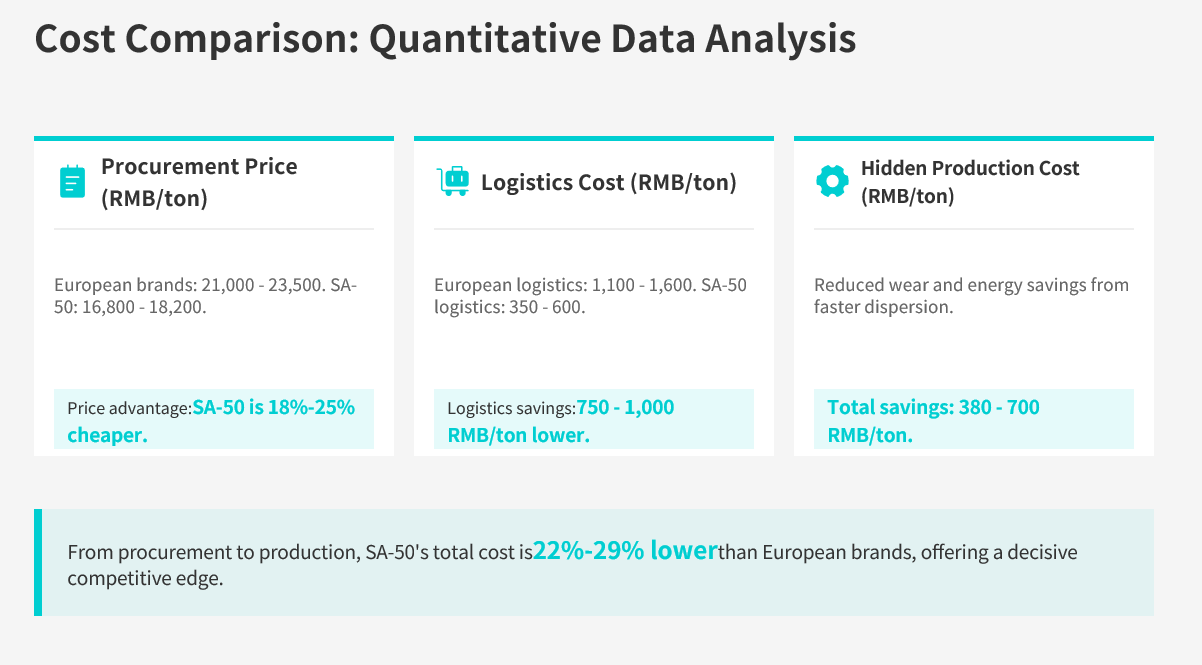
Polyester fiber producers face a persistent trade-off: European fiber grade TiO₂ products offer proven performance but carry high unit prices (21,000–23,500 RMB/MT CIF Asia) and long delivery times (35–60 days). Lower-cost alternatives from Asia may compromise quality—causing black spots, crystal points, excessive spinneret wear, or inconsistent batch stability. The production manager needs a product that delivers reliable spinning performance without the cost penalty of European imports, while maintaining stable PET viscosity and avoiding process disruptions.
Industry Background
The anatase crystalline form of TiO₂ is preferred for fiber grades because of its lower Mohs hardness (5.5–6.0) compared to rutile (6.0–7.0), reducing abrasion on spinning nozzles. Fiber grade TiO₂ typically requires a particle size of 0.2–0.3 μm for optimal delustering in polyester staple fibers, as reported by industry guides. Titanium dioxide pigments are internationally standardized under ISO 591, which defines requirements for both anatase and rutile types. China remains the world's largest TiO₂ exporter, shipping a record 1.9017 million tons in 2024, a 15.84% increase year-on-year (China Customs Statistics). Against this backdrop, Orient International offers a domestically produced alternative that aims to close the performance gap with European grades while dramatically lowering total cost.
Detailed Solution: SA-50 by Orient International
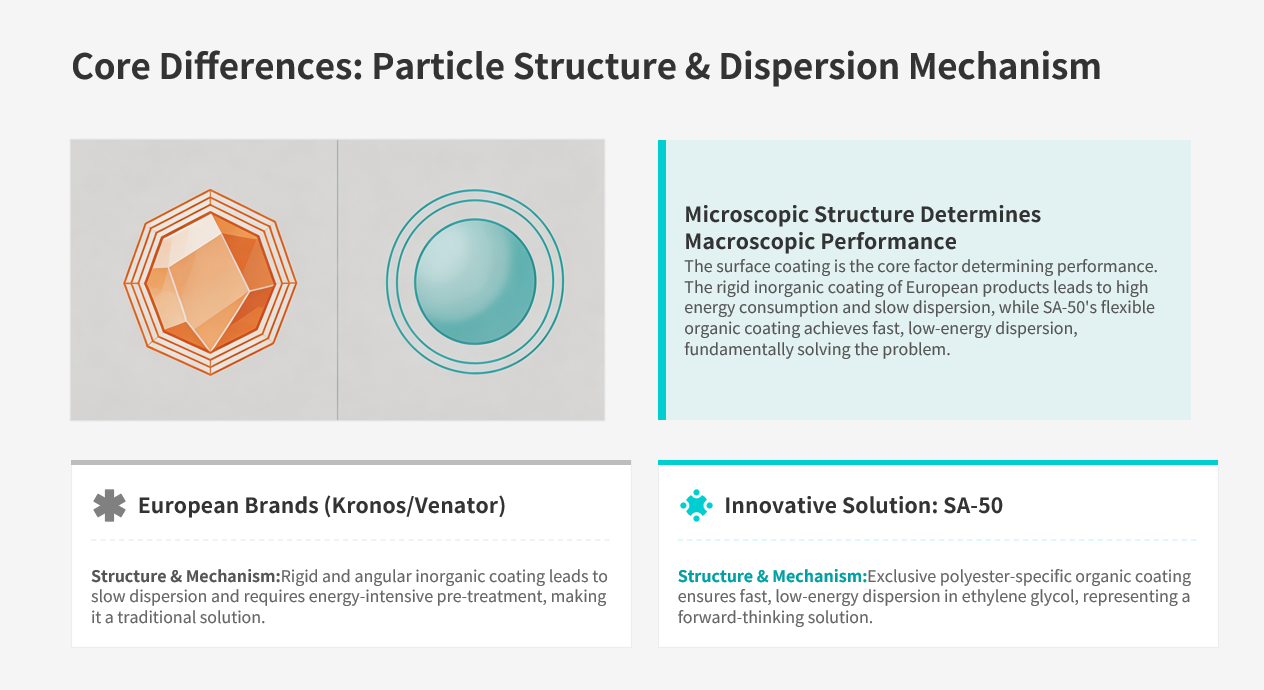
ORIENT INTERNATIONAL HOLDING SHANGHAI FOREIGN TRADE CO., LTD is a state-owned foreign trade enterprise founded in 1988, with a registered capital of over RMB 548 million. Its titanium dioxide production facility covers 700,000 m², employs 160 people, and has an annual output of 16,000 MT. The product in focus, SA-50, is a polyester-specific fiber grade anatase TiO₂ that incorporates an exclusive special organic coating developed through Japanese refined dry modification technology. Unlike the traditional silicon-aluminum inorganic double coating used by Kronos 1071 and Venator LW-S100, SA-50's organic coating achieves dual compatibility with ethylene glycol and polyester resin. This enables rapid dispersion without pre-infiltration—a key advantage in PET in-reactor polymerization and continuous spinning lines.
Step-by-Step Breakdown of Advantages
1. Color Performance
SA-50 delivers a cool blue-white shade with a b-value ≤ -0.4, whereas European grades typically exhibit a warm yellow tone with b-values of +0.8 to +1.7. This makes SA-50 more suitable for high-grade light-color and pure-white polyester fabrics.
2. Dispersion Efficiency
Thanks to its organic coating, SA-50 disperses 20%–30% faster than European equivalents. No heating pretreatment is required during glycol batching, saving 55%–62% of energy in that step alone.
3. Spinning Stability
SA-50 maintains stable PET viscosity during polymerization, without black spots or crystal points. Batch stability fluctuation is 1%–3% lower than European grades—a difference negligible for normal production.
4. Maintenance Reduction
Spinneret replacement frequency is 40% less; filter consumption is 25% less; pipeline cleaning intervals extend from monthly to 2 months. Overall maintenance workload is reduced by over 50%.
5. Cost Savings & Energy Efficiency
SA-50's total comprehensive cost is 22%–29% lower than European Kronos 1071 and Venator LW-S100, with a unit price gap of 4,200–5,300 RMB/MT and logistics savings of 750–1,000 RMB/MT. Hidden production savings from less spinneret wear and faster dispersion range from 380–700 RMB/MT. Energy use in extrusion drops 9%–14%, with indirect savings from 30% less downtime adding another 4%–7%.
Use Cases
- PET in-reactor polymerization matting: Ideal for semi-dull and full-dull PET chips, optimized for ethylene glycol pre-dispersion feeding, compatible with high-speed POY, FDY, and DTY continuous spinning.
- High-grade light-color & pure-white polyester fabrics: The cool blue-white shade eliminates yellowish cast, delivering cleaner fabric appearance.
- Long-cycle continuous high-yield spinning lines: Reduced spinneret abrasion (3%–8% lower) and lower filter blockage suit 7×24 operation.
- Cost-sensitive global PET markets: Fast delivery, flexible MOQ from 1 MT, and flexible trial orders for factories in China, Southeast Asia, India, Korea, and the Middle East.
Comparison Table: SA-50 vs European Kronos 1071 & Venator LW-S100
| Parameter | SA-50 (Orient International) | European Kronos 1071 / Venator LW-S100 |
|---|---|---|
| Unit Price (CIF Asia) | 16,800–18,200 RMB/MT | 21,000–23,500 RMB/MT |
| Total Comprehensive Cost Gap | 22%–29% lower | Baseline |
| Color Tone (b-value) | Cool blue-white (≤ -0.4) | Warm yellow (+0.8 to +1.7) |
| Dispersion Speed | 20%–30% faster; no pre-infiltration | Baseline; 2–4h pre-heat required |
| Glycol Batching Energy | 55%–62% lower consumption | Baseline |
| Spinneret Lifespan | 12%–18% longer | Baseline |
| Maintenance Workload | Reduced by >50% | Baseline |
| Delivery Time | Reduced >50% (flexible MOQ 1 MT) | 35–60 days |
Frequently Asked Questions (FAQ)
- 1. Are SA-50 products certified to international standards such as ISO 591?
- SA-50 conforms to the anatase-grade requirements defined in ISO 591 for titanium dioxide pigments. While specific textile certifications like OEKO-TEX ECO PASSPORT have been obtained by certain competing products (e.g., Venator LW-S100 in 2022), Orient International can provide compliance documentation upon request. Customers requiring specific certifications for end-product labeling are advised to verify with their quality team or contact Orient International directly.
- 2. How does SA-50's spinning performance compare with European grades in terms of breakage and filter cycles?
- SA-50 demonstrates filament breakage gap ≤5% and filter cycle gap ≤5% compared to European Kronos 1071 and Venator LW-S100. Spinneret wear is 3%–8% lower with SA-50 due to its smoother particle surface. Batch stability fluctuation is 1%–3% lower, which is negligible for normal production.
- 3. What is the actual cost difference per metric ton when switching from European TiO₂ to SA-50?
- The unit cost of SA-50 is 18%–25% lower than European imports, translating to a 4,200–5,300 RMB/MT saving on the purchase price alone. Including logistics (saving 750–1,000 RMB/MT) and hidden production savings from reduced spinneret wear and faster dispersion (380–700 RMB/MT), the total comprehensive cost advantage reaches 22%–29%. A 10,000 MT annual order can save over 4.5 million RMB.
- 4. Can I obtain a small sample of SA-50 for a trial run before committing to a full order?
- Yes, Orient International supports flexible trial orders starting from 1 MT. For sample requests, contact Alex Wu via sales@petchemical.com or WhatsApp: +86 18928113542. Quick sample shipments help reduce evaluation time.
- 5. What is the typical lead time for SA-50 and how does it compare with European suppliers?
- SA-50 delivery time is reduced by over 50% compared to European ocean freight (35–60 days). Domestic and short-sea logistics take 350–600 RMB/MT in freight cost and arrive in days rather than weeks, also halving the capital occupation cycle for buyers. Minimum order quantity is flexible from 1 MT for trial orders.
To request a sample, quote, or detailed product brochure, contact Alex Wu by email at sales@petchemical.com or via WhatsApp.
Conclusion
For polyester fiber manufacturers seeking to reduce raw material costs without sacrificing spinning stability, SA-50 from Orient International offers a compelling alternative to established European fiber grade titanium dioxide brands. Its proprietary organic coating—using Japanese refined dry modification—delivers faster dispersion, a brighter blue-white shade, reduced maintenance, and 22%–29% lower total cost compared to Kronos 1071 and Venator LW-S100. With a state-owned enterprise backing, flexible order sizes, and a dedicated global supply chain, SA-50 is positioned as a reliable, cost-optimized choice for today's competitive fiber market.
Download the full company brochure for more details:
Orient International Corporate Brochure (EN PDF)
Have Questions or Need More Details?
Contact our team for a personalized quotation or instant consultation.
Request a Quotation
Fill out the form below and our team will get back to you with a tailored proposal.
WhatsApp Direct Chat
Prefer to chat in real-time? Message us on WhatsApp for instant assistance & quick answers.
- Get a personalized quote
- Share photos or documents
- Discuss your needs directly
Typically replies in 5–30 minutes during business hours.