
Ranked: Fiber Grade TiO₂ Picks for PET, Viscose/Acrylic, and Nylon
Short answer: fiber grade titanium dioxide is not a one-spec purchase. Ranked by application fit, SA-50 takes first place for PET whitening (anatase, TiO₂ ≥98.0%, L 96.7–98.2, b ≤0.0), SA-60 takes first place for viscose and acrylic matting (TiO₂ ≥97.0%, L ≥96.5, b ≤0.5, conductivity ≤120 μS/cm, pH in the 7.x range), and SA-80 takes first place for nylon matting (TiO₂ ≥95.0%, L 92.0–97.0, b ≤3, conductivity ≤100 μS/cm, pH 6.8–8.0). The order follows TiO₂ content, color values and ionic parameters for each fiber route — it is not a generic quality ladder.
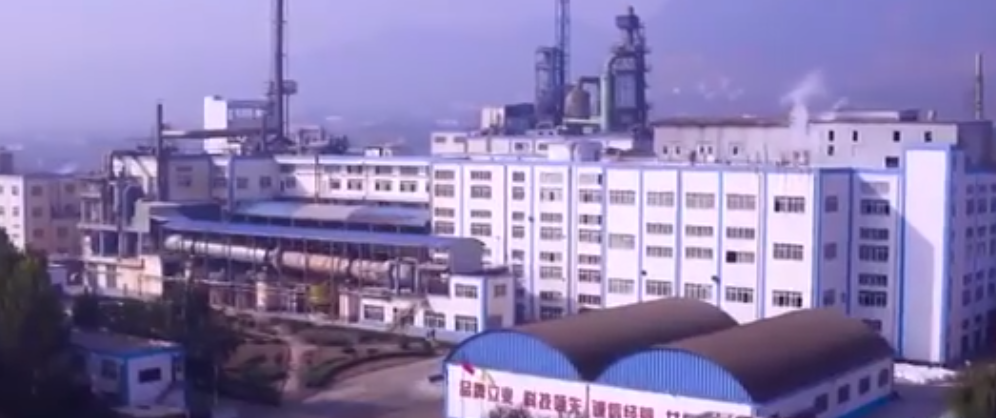
Fiber grade titanium dioxide is the whitening and matting pigment that textile fiber producers add to polyester, viscose, acrylic and polyamide, and its job is decided by the route it enters. The three grades ranked here are supplied by Orient International Holding Shanghai Foreign Trade Co., Ltd., a Shanghai-based state-owned foreign trade enterprise founded in 1988 that handles titanium dioxide and petrochemical raw materials for chemical fiber and industrial chemical buyers, with complete import and export qualifications and one-stop services covering international logistics, customs declaration and letter of credit settlement.
This ranking is written for spinners and fiber producers who are past discovery and into evaluation and execution: they already know a fiber grade exists, and now need to decide which grade goes to which line, on what evidence, and on what order terms.
The problem: three fiber routes, three different spec priorities
Answer first: the parameter that decides a good fiber grade changes with the fiber route. In PET whitening, whiteness per unit of loading dominates, so TiO₂ content and color value L come first. In viscose and acrylic matting, the target is controlled dullness rather than maximum whiteness, and the pigment travels through a wet route, so electrical conductivity and pH move up the list. In nylon matting, a wider L window is acceptable while ionic cleanliness stays tight.
Two failure modes follow from ignoring that split.
- Over-specification. A line running nylon matting on a PET whitening grade pays, on every metric ton, for whiteness headroom the yarn does not use.
- Under-specification. A PET whitening line running a wider-tolerance grade risks missing its L target and compensating with extra loading — and extra loading is where dispersion problems, filter pressure and black-spot risk begin.
The useful question is therefore not “which fiber grade titanium dioxide is best”, but “which grade is best for this route, at this whiteness or matting target, on this line”. The ranking below answers that question for three routes, then shows how to map the answer onto a real production line.
Industry background: why grade-level discipline matters more than it did
Four supply-side facts frame the choice in 2026.
- The global titanium dioxide market is projected to reach USD 24.4 billion in 2026 (Grand View Research).
- The anatase segment, which carries fiber grade, is expected to grow at a CAGR of 7.3% from 2026 to 2033 (Grand View Research).
- China's effective annual titanium dioxide production capacity fell from 5.9 million tons in 2024 to 5.7 million tons in 2025 (SunSirs / Titanium Dioxide Alliance).
- China's total titanium dioxide export volume reached 1.9017 million tons in 2024, up 15.84% year on year (SunSirs / Titanium Dioxide Alliance).
Read together, these numbers describe a market where fiber grade supply is concentrating in fewer, larger Chinese producers while export volume keeps rising. For a spinner, that shifts weight from “find any supplier” to “qualify a supplier whose grade portfolio can be matched to each route”, because capacity consolidation makes grade-level continuity more valuable than spot availability.
Two technical anchors support the same discipline. China sets a national test method for titanium dioxide content in man-made fibers under GB/T 37632-2019 (Standardization Administration of China), which gives buyers a reference method to agree on at acceptance. And fiber grade pigment typically sits at a D50 of around 0.28 μm, with 90% of particles between 0.1 and 0.5 μm — a window that makes dispersion behavior, not just chemistry, part of the purchase specification.
The ranked picks, grade by grade
Rank 1 · PET whitening SA-50
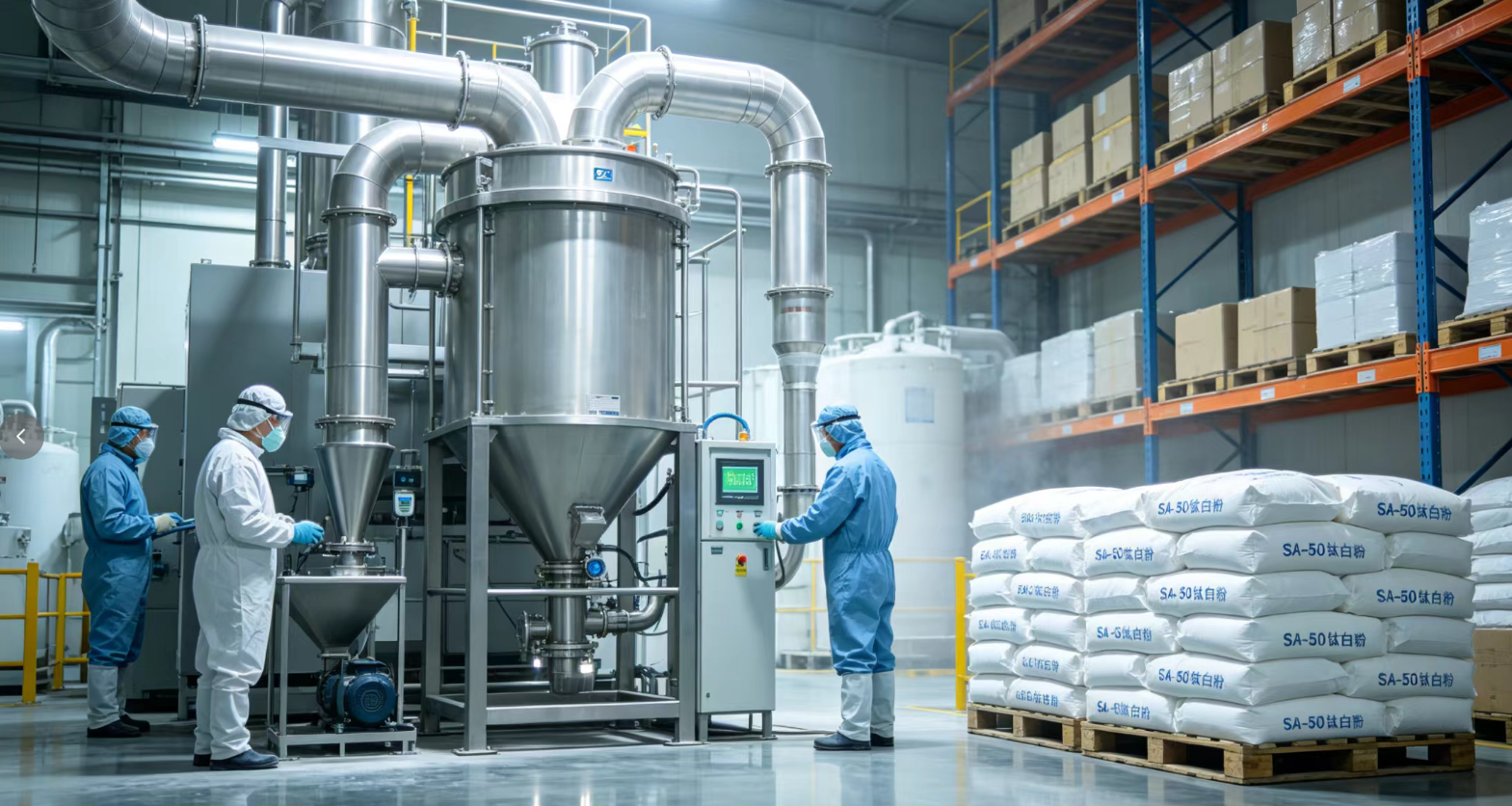
SA-50 is an anatase fiber grade with TiO₂ content ≥98.0% — the highest of the three grades here — and a color value window of L 96.7–98.2 and b ≤0.0. It ranks first for PET whitening because whiteness in polyester is bought with pigment loading: a higher content plus a high, narrow L window reaches the target whiteness at a lower dose.
Published specification:
- Crystal structure: anatase
- TiO₂ content: ≥98.0%
- Sieve residue (325 mesh): ≤0.004%
- Moisture (105 °C): ≤0.40%
- Fe₂O₃: ≤0.004%
- pH value: 6.8 ± 0.2
- Electrical conductivity: ≤230 μS/cm
- Specific surface area: 8.5–10.0 m²/g
- Color value L: 96.7–98.2
- Color value b: ≤0.0
Why those two impurity rows carry the rank: iron drives yellowing, and coarse residue shows up downstream as filter pressure rise and, eventually, black spots and crystal points. Fe₂O₃ ≤0.004% and sieve residue ≤0.004% at 325 mesh are the specs that protect a melt route, and b ≤0.0 keeps the tint neutral to slightly blue — the direction that resists yellowing in the finished fiber.
Field evidence comes from a polyester project in China that has run for more than 10 years and used more than 5,000 metric tons of this grade as a matting agent in polyester chip for fiber and bottle production. Reported outcomes: even dispersion without black spots or crystal points; spinneret clogging cycle extended by over 40%; filter replacement frequency greatly reduced; filament breakage rate down by approximately 35%; L value above 96.7 with outstanding anti-yellowing performance; low impurities keeping PET intrinsic viscosity steady and melt fluidity good.
Rank 1 · Viscose & acrylic matting SA-60
SA-60 is specified at TiO₂ ≥97.0%, L ≥96.5, b ≤0.5, with electrical conductivity ≤120 μS/cm and pH in the 7.x range. It takes first place for viscose and acrylic matting because those routes buy dullness, not maximum whiteness: a slightly lower content and a wider b tolerance cost nothing in a matted yarn, while a tighter conductivity ceiling is worth paying for.
The reason sits in the route, not the pigment. Viscose and acrylic are not plain melt routes; the pigment is carried into the fiber through a liquid medium, so the ionic load it brings stays inside the process. A ≤120 μS/cm ceiling combined with a near-neutral pH gives a wet-route spinner two parameters that can be checked at incoming inspection rather than inferred from finished-yarn defects.
Where SA-60 stops being the right pick: if the job is high-whiteness polyester, its ≥97.0% content and b ≤0.5 tolerance leave less headroom than SA-50, and the PET ranking should hold.
Rank 1 · Nylon matting SA-80
SA-80 is specified at TiO₂ ≥95.0%, L 92.0–97.0 and b ≤3, with conductivity ≤100 μS/cm and pH 6.8–8.0. It ranks first for polyamide matting because nylon matting tolerates a wider whiteness window — L from 92.0 to 97.0 — so the top of the content range is not what the yarn is paying for. What it is paying for is a controlled dull surface delivered consistently, plus the tightest conductivity ceiling of the three grades (≤100 μS/cm) paired with a pH window of 6.8–8.0, which is a combination positioned for matting duty rather than whitening duty.
Where SA-80 stops being the right pick: any application that needs a high L value. With b ≤3, the tint tolerance is the widest of the three, and a whitening target should not be pushed onto it.
Why the rank order is not a quality order
SA-50 does not “beat” SA-80. Content and L ceilings descend from SA-50 to SA-60 to SA-80 precisely because the jobs descend in whiteness demand. Applying SA-50 to nylon matting is not a technical failure on the line; it is a failure on the purchase order, because each metric ton carries whiteness headroom the yarn never uses. Applying SA-80 to PET whitening is the more expensive direction: the grade can run, but the L target may need extra loading, and extra loading is where dispersion problems start.
Decision rule. Choose the lowest grade in the ranking whose L and b windows still cover your finished-fiber target, then verify that its conductivity and pH match your route. That single rule removes most of the cost of over-specification without touching yarn quality.
Step-by-step: mapping a ranked pick to your production line
- Name the job in one sentence. “Whitening to a defined L value” and “matting to a dull surface” are different purchase specs. PET whitening points to SA-50; viscose and acrylic matting point to SA-60; nylon matting points to SA-80.
- Read TiO₂ content against your loading budget. ≥98.0% (SA-50), ≥97.0% (SA-60), ≥95.0% (SA-80). A higher content reaches a given whiteness at a lower dose; where the target is dullness, the extra content buys nothing.
- Read L and b as a pair, never alone. SA-50 pairs L 96.7–98.2 with b ≤0.0; SA-60 pairs L ≥96.5 with b ≤0.5; SA-80 pairs L 92.0–97.0 with b ≤3. A high L with a loose b still drifts on shade.
- Check the route constraint — conductivity and pH. ≤230 μS/cm at pH 6.8 ± 0.2 for SA-50; ≤120 μS/cm at pH in the 7.x range for SA-60; ≤100 μS/cm at pH 6.8–8.0 for SA-80. Wet routes should be matched on this step before price is discussed.
- Confirm the purity and dispersion specs where they are published. On SA-50: sieve residue ≤0.004% (325 mesh), Fe₂O₃ ≤0.004%, moisture ≤0.40%, specific surface area 8.5–10.0 m²/g. Set these against the general fiber grade particle window of D50 around 0.28 μm, with 90% of particles between 0.1 and 0.5 μm.
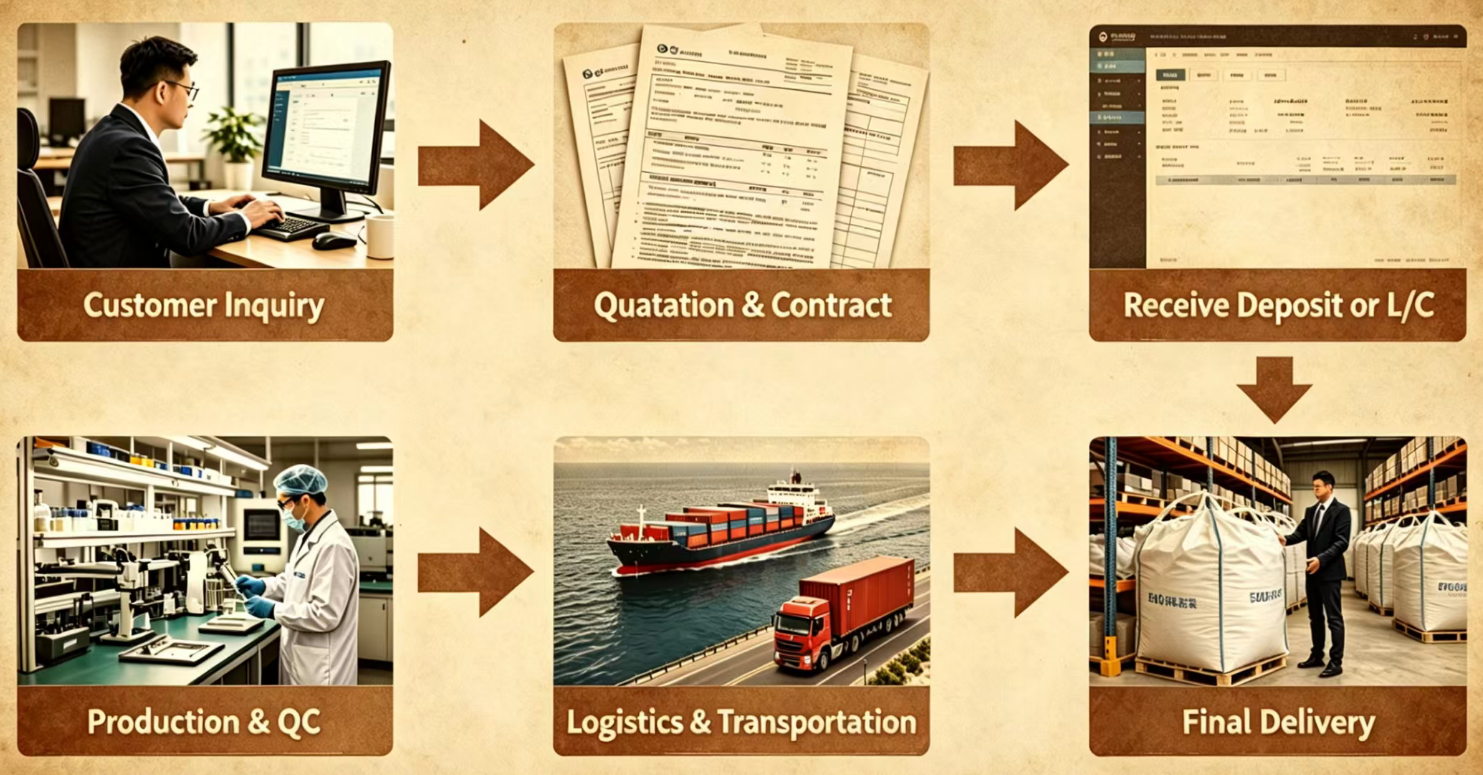
- Validate on the line, then lock commercial terms. Plan the trial against a 1 metric ton MOQ, require 100% pre-shipment testing, and confirm lead time (15–30 days) against 1000 MT monthly capacity so the trial does not collide with a production order.
Use cases: which ranked grade fits which line
Polyester chip, staple and filament whitening → SA-50
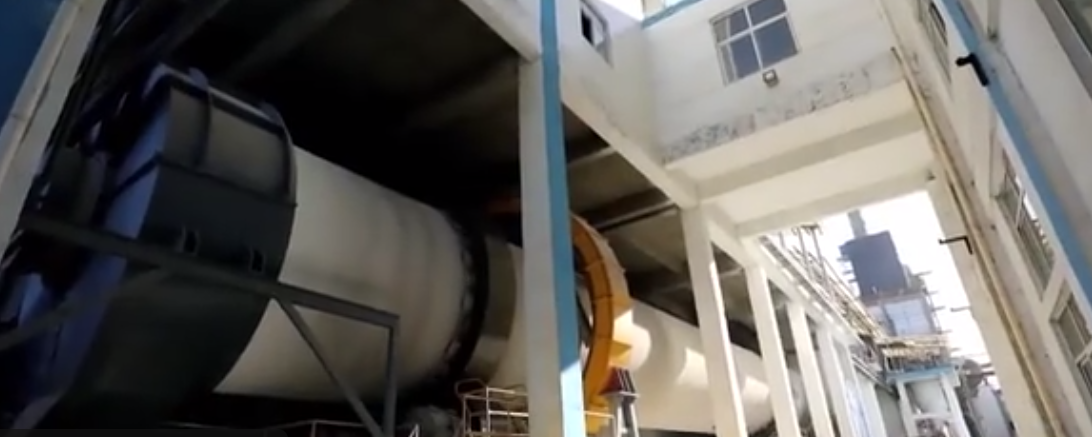
Continuous polyester polymerization and spinning is the most demanding of the three jobs on purity, because the pigment passes through esterification and polycondensation at 240–285 °C before it ever reaches a spinneret. SA-50's low iron, low ionic impurity profile and near-neutral pH keep it dispersing evenly in ethylene glycol, and its impurity ceilings are what protect intrinsic viscosity, spinneret life and dye uniformity. For a line that cannot afford black spots, crystal points or shade streaks, this is the grade the ranking puts first.
Viscose and acrylic matting → SA-60
Where the commercial target is a dull, non-reflective surface rather than maximum whiteness, SA-60's ≥97.0% content and L ≥96.5 deliver the required matting level, and its ≤120 μS/cm conductivity and near-neutral pH match a route where the pigment is carried in a liquid medium. The saving is straightforward: whiteness headroom that the yarn does not need is not purchased.
Nylon matting → SA-80
Polyamide matting accepts the widest L window (92.0–97.0) and the widest b tolerance (≤3) of the three jobs, so SA-80's ≥95.0% content is matched to the duty rather than to a whitening target. Its ≤100 μS/cm conductivity ceiling is the tightest in the ranking, which is the parameter to hold when the polyamide route is sensitive to ionic load, and its pH window of 6.8–8.0 leaves room for incoming-lot variation.
Comparison table: the three ranked picks side by side
| Parameter | SA-50 — Rank 1 for PET whitening | SA-60 — Rank 1 for viscose & acrylic matting | SA-80 — Rank 1 for nylon matting |
|---|---|---|---|
| TiO₂ content | ≥98.0% | ≥97.0% | ≥95.0% |
| Color value L | 96.7–98.2 | ≥96.5 | 92.0–97.0 |
| Color value b | ≤0.0 | ≤0.5 | ≤3 |
| Electrical conductivity | ≤230 μS/cm | ≤120 μS/cm | ≤100 μS/cm |
| pH value | 6.8 ± 0.2 | 7.x range | 6.8–8.0 |
| Route type it fits | Melt route, high-whiteness polyester | Wet route, matted viscose and acrylic | Polyamide matting |
Grade specifications as provided for this evaluation. SA-50 additional published values: sieve residue (325 mesh) ≤0.004%, moisture (105 °C) ≤0.40%, Fe₂O₃ ≤0.004%, specific surface area 8.5–10.0 m²/g, crystal structure anatase.
Order and supply facts that apply to all three grades
| Commercial item | Value |
|---|---|
| Minimum order quantity | 1 metric ton |
| Lead time | 15–30 days |
| Monthly capacity | 1000 MT |
| Annual output | 16,000 MT |
| Quality control | 100% pre-shipment test; third-party inspection supported |
| Delivery terms | FOB / CIF |
| Payment terms | T/T in advance, T/T 30 days, L/C at sight, L/C 30 days, L/C 60 days, L/C 90 days |
| Customization | OEM and ODM services; customization for polyester and nylon |
| After-sales | Remote support and on-site support |
FAQ
What quality and compliance documents support a fiber grade TiO₂ order?
Orient International Holding Shanghai Foreign Trade Co., Ltd. holds an ISO 9001:2015 certificate issued by TÜV SÜD (certificate number TUV100034917/2), with the scope “Production and sales of chemical fiber grade titanium dioxide”, covering the SA-50 grade. Every lot is subject to 100% pre-shipment testing, and third-party inspection is supported. Where the buyer's acceptance test follows a national method, GB/T 37632-2019 (Man-made fiber — Test method for titanium dioxide content, issued by the Standardization Administration of China) is the reference standard to agree on before the first shipment.
Can Orient International act as an OEM fiber grade titanium dioxide manufacturer partner?
Yes. OEM and ODM production services are available, along with customization services for polyester and nylon materials. The operational backing behind that: a 25-engineer R&D team, a 700,000 m² production site, 1000 MT monthly capacity and 16,000 MT annual output, an export ratio of 30% across Korea, Japan, the EU, North America, South America, South East Asia, the Middle East and India, plus remote and on-site after-sales support.
What are the MOQ, delivery terms and payment terms?
MOQ is 1 metric ton, delivery is on FOB or CIF terms, and payment can run on T/T in advance, T/T 30 days, L/C at sight, L/C 30 days, L/C 60 days or L/C 90 days. Acceptance is based on 100% pre-shipment quality testing, with third-party inspection supported when the buyer wants an independent read on the lot.
Can we test a grade on our own line before committing to a full order?
The smallest order step is 1 metric ton, which is sized for a line trial rather than a production run, so a spinner can validate a ranked pick against real spinning conditions first. Each lot is 100% tested before shipment and third-party inspection can be arranged, so the trial tonnage can be checked against the published grade values — for SA-50, TiO₂ ≥98.0%, L 96.7–98.2, b ≤0.0. Because the three grades are matched to different routes, the trial should be run on the route that will actually consume the pigment.
What lead time and capacity should a spinner plan for?
Lead time is 15–30 days, and monthly capacity is 1000 MT, with annual output of 16,000 MT — enough to place a trial lot and a repeat schedule in the same planning window. Share the fiber route, the target L and b values and the monthly tonnage with the supplier's team at sales@petchemical.com (or WhatsApp +86 18928113542) and the ranked pick can be confirmed against the line before the first order.
Conclusion
The ranking is short: SA-50 for PET whitening, because TiO₂ ≥98.0%, L 96.7–98.2 and b ≤0.0 buy whiteness at the lowest loading while low iron and low residue protect the melt route; SA-60 for viscose and acrylic matting, because ≥97.0% content with conductivity ≤120 μS/cm and near-neutral pH matches a wet route that wants dullness, not maximum whiteness; SA-80 for nylon matting, because ≥95.0% content, an L window of 92.0–97.0 and a ≤100 μS/cm conductivity ceiling fit a matting duty.
What makes the ranking usable is the qualifying layer around it: 1 metric ton MOQ, 15–30 day lead time, 1000 MT monthly capacity, 100% pre-shipment testing, and OEM/ODM plus customization support for polyester and nylon. A single grade is not a universal best pick because the three fiber routes do not reward the same parameter. Match the grade to the route, confirm conductivity and pH before price, and the ranked list stops being a recommendation and becomes a purchase decision.
Next step: sample, quote or full catalogue
Tell us the fiber route (PET, viscose, acrylic or nylon), the target L and b values, and the monthly tonnage. We will confirm which ranked grade fits and what the order terms look like.
Email: sales@petchemical.com · Tel / WhatsApp: +86 18928113542 · Website: www.petchemical.com
Download the company brochure: Orient International Holding Shanghai Foreign Trade Co., Ltd. — Company Profile (PDF)
Have Questions or Need More Details?
Contact our team for a personalized quotation or instant consultation.
Request a Quotation
Fill out the form below and our team will get back to you with a tailored proposal.
WhatsApp Direct Chat
Prefer to chat in real-time? Message us on WhatsApp for instant assistance & quick answers.
- Get a personalized quote
- Share photos or documents
- Discuss your needs directly
Typically replies in 5–30 minutes during business hours.