
Fiber Grade TiO₂ Application Guide: Batch Pre-Dispersion and Continuous Feeding on PET Chip Lines
On a PET chip line built around batch pre-dispersion, fiber grade titanium dioxide is never dosed as dry powder. It arrives at the reactor as an ethylene glycol slurry — dispersed in a batch tank, held under low-speed stirring at 40–60 °C, moved through a closed vacuum feeding system, and metered continuously into esterification and polycondensation. Whether that slurry stays uniform from the pre-dispersion tank to the metering pump decides the matting level, the filter life and the black-spot count of the finished chip.
The grade used throughout this guide is SA-50, the anatase fiber grade titanium dioxide supplied by ORIENT INTERNATIONAL HOLDING SHANGHAI FOREIGN TRADE CO., LTD. — a Shanghai-based foreign trade enterprise founded in 1988 under Orient International Group, handling titanium dioxide and petrochemical raw materials at an annual output of 16,000 MT, with exports to Korea, Japan, the EU, North America, South America, South East Asia, the Middle East and India (www.petchemical.com).
This is a commissioning-level guide, not a product overview. It assumes the line already owns a pre-dispersion tank, a day tank and a continuous TiO₂ feeding dispersion system. Lines that inject dry pigment directly should not map these settings across.
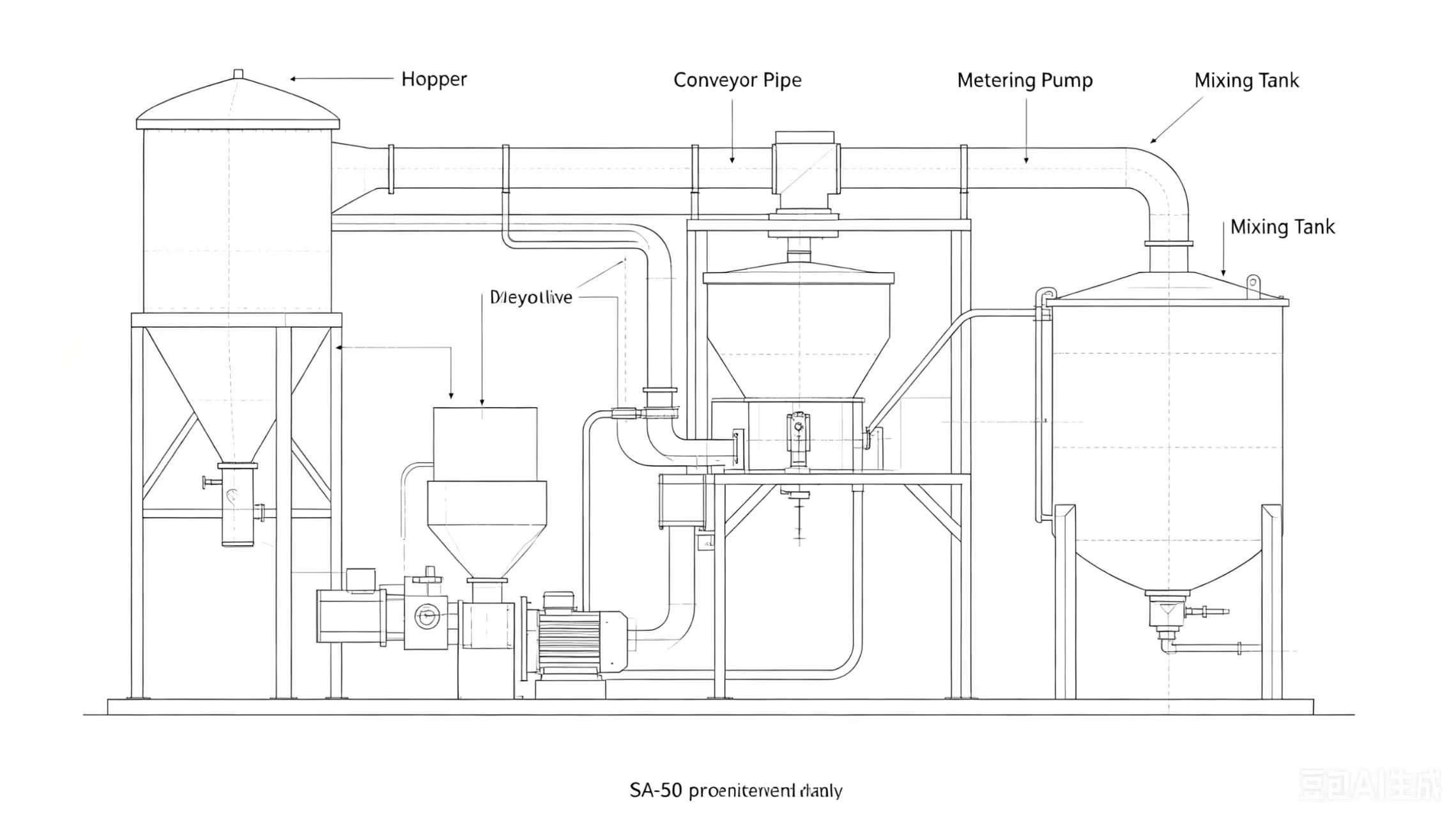
Problem Definition: Three Failure Modes That Start at the Day Tank
In a batch pre-dispersion route the pigment has already been wetted before it reaches polymerization, so the engineering question is no longer how to disperse TiO₂ — it is how to keep a dispersed slurry dispersed through storage, vacuum transfer and metering. Three failure modes account for most of the trouble on this type of line.
1. Settling inside the pre-dispersion tank
A slurry that is left standing separates. SA-50 is characterised by even dispersion in ethylene glycol without sedimentation or agglomeration, but that behaviour depends on the slurry being kept in motion and inside its temperature window. A tank that is stirred intermittently, or allowed to cool below the working range, delivers a lean slurry at the start of pumping and a heavy one at the end. The chip lot then carries a matting level that drifts from start to finish.
2. Secondary agglomeration at melt temperature
Particles that were separated in glycol can recombine once they meet the 240–285 °C environment of esterification and polycondensation. Agglomerates of that size are the usual origin of black spots and crystal points, and they are what loads the filter and blocks the spinneret. Dispersion quality therefore has to survive the reactor, not only the mixing tank — which is why the feeding stage, not the mixing stage, is usually the true constraint.
3. Dosing drift between batches
When every batch is prepared separately, small differences in solids content, wetting time or transfer volume become a matting-level difference across the chip lot. Continuous feeding removes the batch boundary only if the slurry arriving at the metering pump is itself consistent. A batch route feeding a continuous reactor mixes two disciplines: batch preparation accuracy and continuous dosing stability.
- Filter or spinneret change-outs happening more often than the line plan allows.
- Color value L trending below 96.7 on finished chip or fiber.
- Visible black spots, crystal points or bright spots on the matte surface.
- Intrinsic viscosity drifting between lots without a change in process settings.
- Matte degree that cannot be held stable from lot to lot.
Industry Background: A Small, Specification-Bound Slice of a Large Market
Titanium dioxide as a whole is a large commodity — Grand View Research projects the global market to reach USD 24.4 billion in 2026. Fiber grade is a narrow, specification-driven slice of it. The same source expects the anatase segment, which is the crystal form used for fiber matting and whitening, to grow at a CAGR of 7.3% between 2026 and 2033.
Supply has been consolidating at the same time. SunSirs and the Titanium Dioxide Alliance report that China's effective annual TiO₂ production capacity fell from 5.9 million tons in 2024 to 5.7 million tons in 2025, while China's total TiO₂ export volume reached 1.9017 million tons in 2024, a 15.84% year-on-year increase. For a chip producer, that combination means fewer qualified sources carrying more of the export load — and a stronger reason to fix the feeding route around a pigment whose batch behaviour is already known rather than re-qualifying a new grade mid-project.
Specification practice is equally narrow. Fiber-grade TiO₂ is generally referenced at a D50 of around 0.28 μm, with 90% of particles falling between 0.1 and 0.5 μm; a coarse fraction outside that window cannot pass a spin pack regardless of how well it was dispersed. In China, GB/T 37632-2019 establishes the test method for titanium dioxide content in man-made fibers, which is the reference a buyer uses when a supplier's certificate of analysis value has to be reproduced in-house before the material is released to the pre-dispersion tank.
Detailed Solution: What SA-50 Brings to an Ethylene Glycol Slurry
SA-50 is an anatase fiber grade titanium dioxide with a declared TiO₂ content of at least 98.0%, a color value L of 96.7–98.2 and a color value b of no more than 0.0. Those three numbers are the ones that decide whether the grade can hold a white, non-yellowing matte on a continuous line. The remaining parameters decide whether it can be pumped.
| Parameter | SA-50 specification | What it does at the feeding stage |
|---|---|---|
| Crystal structure | Anatase | Milder particle hardness than rutile, which limits spinneret abrasion during high-speed spinning. |
| TiO₂ content | ≥98.0% | Sets the pigment load per kilogram of slurry; a stable value keeps matting degree calculable from dosing rate. |
| Color value L | 96.7–98.2 | Whiteness on finished chip and fiber; the working floor for lot release is L above 96.7. |
| Color value b | ≤0.0 | Controls the yellow-blue axis, which is the anti-yellowing indicator most spinners track. |
| Fe₂O₃ | ≤0.004% | Low iron means low ionic impurity load entering esterification. |
| Electrical conductivity | ≤230 μs/cm | Indicates the soluble ionic level of the pigment; high conductivity is a side-reaction risk in polymerization. |
| pH value | 6.8 ± 0.2 | Neutral surface chemistry, the basis of slurry stability and hydrolysis resistance in storage. |
| Moisture (105 °C) | ≤0.40% | Free moisture carried into vacuum transfer and the reactor; high moisture causes steaming and lumping. |
| Sieve residue (325 mesh) | ≤0.004% | The coarse fraction that a spin pack actually sees; this is the black-spot and blockage filter. |
| Specific surface area | 8.5–10.0 m²/g | Governs how quickly the powder wets out when it is charged into ethylene glycol. |
Anatase structure and spinneret wear
Anatase is the correct crystal form for polyester matting, and on this route its value is mechanical as much as optical. In the Chinese polyester project described later in this guide, mild anatase particles lessened spinneret abrasion, the filament breakage rate fell by about 35%, and the spinneret clogging cycle was extended by over 40%. Those results come from the combination of crystal form, particle softness and dispersion quality — not from pigment concentration alone.
Low iron, low conductivity and neutral pH
Fe₂O₃ at no more than 0.004% and electrical conductivity at no more than 230 μs/cm keep the ionic load entering esterification low. In practice, SA-50 disperses evenly in ethylene glycol without sedimentation or agglomeration and remains stable at 240–285 °C during PET esterification and polycondensation without reducing PET intrinsic viscosity, causing side reactions or producing black spots. The neutral pH of 6.8 ± 0.2 is the parameter behind the hydrolysis resistance the slurry needs while it waits in the day tank: a neutral anatase surface stays stable in a glycol medium that still carries a small amount of moisture.
Moisture and sieve residue: the two figures the feeding system feels first
Moisture at no more than 0.40% is what a closed vacuum transfer line sees. Wet pigment foams, bridges in the hopper and can flash into steam when it meets the melt. Sieve residue at no more than 0.004% on 325 mesh is what the spin pack sees. Neither value can be corrected downstream — a coarse particle that leaves the pre-dispersion tank will still be coarse at the spinneret, whatever the stirring time.
The feeding system is part of the pigment specification
A continuous TiO₂ feeding dispersion system is not an accessory to the pigment choice; on this route it is a condition of it. The system has to deliver a constant solids load to the metering pump, keep the slurry closed to plant air, and hold temperature in the 40–60 °C band from the pre-dispersion tank through to injection. A grade that meets the COA but is fed through an open, intermittently stirred tank will not reproduce the dispersion behaviour the specification describes.
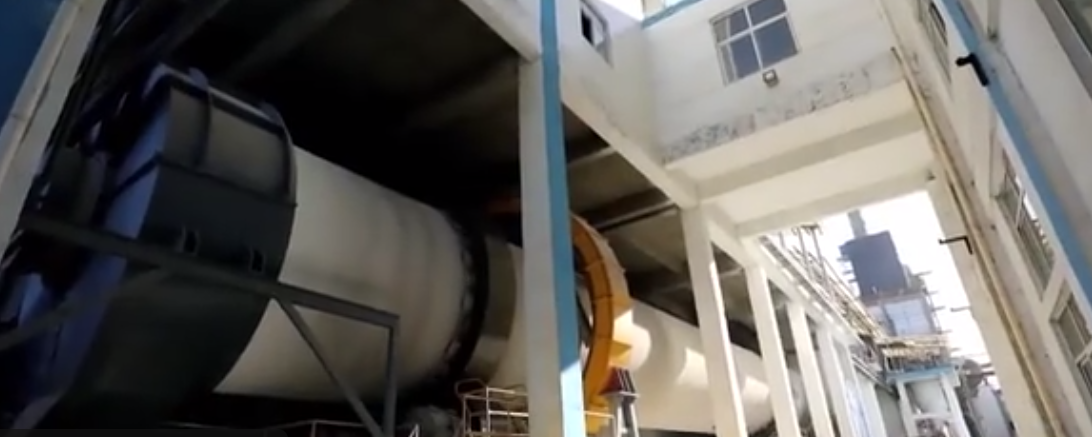
Step-by-Step Breakdown: Commissioning the Route
The sequence below is the working order for a line that prepares its own slurry. Each step has a release criterion; skipping a criterion moves the failure downstream where it is far more expensive to find.
Step 1 — Verify incoming moisture before anything else
Store fiber grade TiO₂ dry, at no more than 65% relative humidity, and keep bags sealed until they are charged. Check the moisture value on the certificate against the ≤0.40% limit and confirm that no bag has taken on water in transit. A damp bag will not disperse cleanly no matter how long it is stirred.
Step 2 — Prepare the batch in ethylene glycol
Charge SA-50 into the pre-dispersion tank and add ethylene glycol to the target solids level. Keep the tank covered during charging to limit dust and air entrainment. Record the actual charge weight rather than the nominal one — this figure becomes the basis for the metering rate later in the sequence.
Step 3 — Disperse at low speed in the 40–60 °C window
Stir at low speed and bring the batch into the 40–60 °C range. Low-speed stirring keeps the slurry homogeneous without folding air into it, and the temperature window lowers viscosity enough for wetting without driving glycol evaporation. High-shear, high-speed mixing is not required at this stage and works against the goal by generating foam.
Step 4 — Release the batch against a written check
Before transfer, confirm the absence of sediment and lumps, verify the solids content against the charge record, and check residue behaviour on the batch. This is the last point at which an out-of-specification slurry can be corrected cheaply.
Step 5 — Transfer under closed vacuum feeding
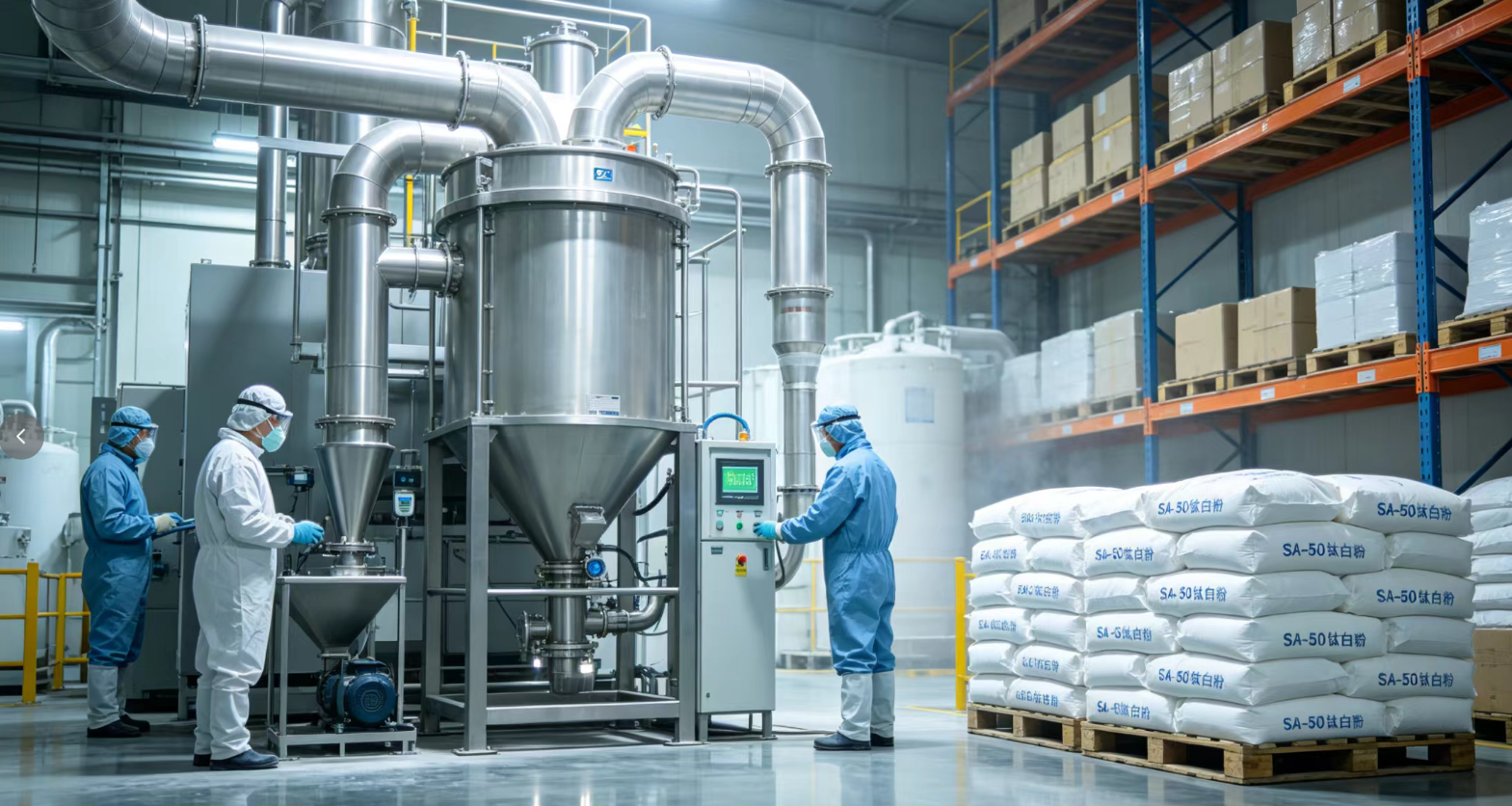
Move the slurry from the pre-dispersion tank to the day tank through the closed vacuum feeding system. Closed transfer keeps the slurry out of contact with plant air, which limits re-agglomeration and evaporation, and it keeps the solids load identical to the batch that was released in Step 4.
Step 6 — Meter continuously into esterification and polycondensation
Feed the slurry at a rate locked to chip throughput, with no manual top-ups between batches. Continuity is the whole point of the route: the reactor should see a constant pigment load through esterification and into polycondensation, where SA-50 remains stable across the 240–285 °C range without reducing intrinsic viscosity.
Step 7 — Close the quality loop on the finished chip
Track four indicators against the baseline: filter and spinneret change-out frequency, color value L, intrinsic viscosity, and black spot count. A rising filter pressure with a stable L value points to dispersion; a falling L value with stable filtration points to dosage or pigment quality. Keeping the two signals apart is what makes the loop useful.
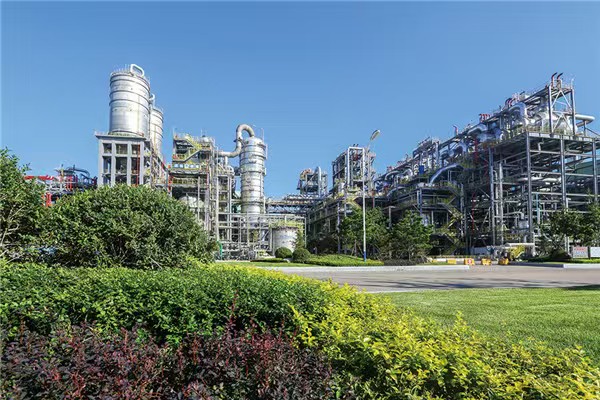
Use Cases: Where This Route Is Already Running
The reference application for this configuration is a polyester producer in China that has used SA-50 for more than ten years, at a cumulative volume of over 5,000 metric tons, as a matting agent in polyester chip for both fiber and bottle production.
Reported outcomes on that project include a spinneret clogging cycle extended by over 40%, filter replacement frequency greatly reduced, color value L above 96.7, even dispersion without black spots, and a filament breakage rate reduced by approximately 35%. High batch consistency allowed the pigment to run on continuous polymerization lines without process modification — the specific property that makes a batch pre-dispersion and continuous feeding route viable in the first place.
Polyester chip for fiber
This is the primary fit. The slurry is metered into esterification ahead of polycondensation, and the chip that leaves the line carries a uniform matte level with a stable L value. Because the pigment does not lower intrinsic viscosity, downstream spinning conditions stay inside their existing window.
Bottle-grade and matting-adjusted chip
The same project supplies chip for bottle production, where matting degree has to be adjustable rather than fixed. A stable adjustable matting degree depends on a stable dosing rate, which returns to Step 3 and Step 6 of the sequence above.
High-speed spinning: filament and staple
On the spinning side, good dispersion prevents secondary agglomeration under high-temperature melting, which is what extends the spinneret clogging cycle and reduces filter replacement. Mild anatase particles reduce spinneret abrasion, and consistent dispersion gives a uniform matte surface without bright spots and even dyeing without streaks. Firm particle adhesion also limits powder fall-off during weaving and dyeing.
Lines running recycled PET feedstock
Recycled feedstock brings its own filtration load to the line, so the Step 7 indicators become the leading signal rather than the L value. When the melt already carries contamination, a dispersion problem and a feedstock problem look similar on the filter; separating them requires the pre-dispersion batch record.
Comparison Table: Pre-Dispersion Stage vs Continuous Feeding Stage
The two stages of this route control different things, and conflating them is a common commissioning error. The table sets out what each stage is responsible for.
| Control point | Batch pre-dispersion stage | Continuous feeding stage |
|---|---|---|
| Temperature | 40–60 °C slurry, low-speed stirring | 240–285 °C in esterification and polycondensation |
| Primary risk | Sedimentation and incomplete wetting in ethylene glycol | Secondary agglomeration, black spots and crystal points |
| What stability means here | No sedimentation or agglomeration while the batch waits | Constant solids load at the metering pump, batch after batch |
| Verification signal | Visual check, solids content, batch residue | Color value L above 96.7, intrinsic viscosity, filter pressure, black spot count |
| Relevant SA-50 parameters | Specific surface area 8.5–10.0 m²/g, pH 6.8 ± 0.2, moisture ≤0.40% | TiO₂ ≥98.0%, Fe₂O₃ ≤0.004%, EC ≤230 μs/cm, sieve residue ≤0.004% |
| Typical consequence of failure | Matting level drifting within one chip lot | Shortened spinneret cycle, higher filament breakage, off-shade fiber |
FAQ
Which test method and certificate should sit behind the TiO₂ content on a fiber grade certificate of analysis?
In China, GB/T 37632-2019 sets the test method for titanium dioxide content in man-made fibers, and it is the reference a buyer uses when a supplier value has to be reproduced in-house. A fiber grade certificate for SA-50 declares TiO₂ ≥98.0%, sieve residue ≤0.004% on 325 mesh, moisture ≤0.40%, Fe₂O₃ ≤0.004%, pH 6.8 ± 0.2, electrical conductivity ≤230 μs/cm, specific surface area 8.5–10.0 m²/g, color value L 96.7–98.2 and color value b ≤0.0. ORIENT INTERNATIONAL HOLDING SHANGHAI FOREIGN TRADE CO., LTD. holds ISO 9001:2015 certification from TUV SUD, certificate TUV100034917/2, with a scope covering the production and sales of chemical fiber grade titanium dioxide.
Can SA-50 run on a continuous polymerization line without process modification?
Yes, within the documented application. In the Chinese polyester project, high batch consistency allowed SA-50 to run on continuous polymerization lines without process modification, and the pigment remains stable at 240–285 °C during esterification and polycondensation without reducing PET intrinsic viscosity, causing side reactions or producing black spots. The condition is the full route: ethylene glycol pre-dispersion, low-speed stirring at 40–60 °C, closed vacuum transfer and continuous metering. The pigment supports the process; it does not replace a missing feeding system.
How do buyers shortlist top fiber grade titanium dioxide manufacturers in China?
A defensible shortlist is built on five checks rather than on a ranking: whether the declared crystal structure and specification match the fiber route; whether the supplier can name the test method behind each certificate value, such as GB/T 37632-2019 for TiO₂ content; whether dispersion behaviour in ethylene glycol is demonstrated rather than asserted; whether capacity and export record can absorb repeat orders; and whether the certification scope actually covers chemical fiber grade production. Orient International fits this profile as an export-oriented supplier founded in 1988, with 16,000 MT annual output, a 30% export ratio, monthly SA-50 capacity of 1,000 MT, MOQ of 1 MT and a lead time of 15–30 days. A genuine ranking still requires side-by-side dispersion and spinning data from the shortlisted grades, which is why sample validation normally comes before any supplier comparison.
How should a sample be validated in ethylene glycol before scale-up?
Run the sample through the same sequence the line will use, at reduced volume: disperse in ethylene glycol, hold low-speed stirring at 40–60 °C, and observe whether the slurry sediments or agglomerates while it stands. Check residue behaviour against the ≤0.004% specification and confirm the moisture value before charging, since storage above 65% relative humidity can change handling behaviour. Then run a pilot batch and compare color value L, intrinsic viscosity and filter pressure against the existing baseline. Orient International applies 100% pre-shipment testing, so the sample and the production lot are checked on the same parameters.
What are the MOQ, lead time and supply terms for SA-50?
MOQ is 1 MT, lead time is 15–30 days, and monthly capacity for the grade is 1,000 MT, with OEM/ODM customization available for polyester and nylon applications. After-sales support is provided remotely and on site. Buyers planning a first production run on a batch pre-dispersion and continuous feeding route should request a sample before fixing the dosing rate — the slurry behaviour in the day tank is easier to confirm on 1 MT than on a full silo. The company brochure, sample request and quotation can be raised through www.petchemical.com or by writing to sales@petchemical.com.
Conclusion: The Slurry, Not the Powder, Is the Specification
Fiber grade titanium dioxide on a PET chip line is a slurry product in everything but the bag. Matching SA-50 to a batch pre-dispersion and continuous feeding route means holding four conditions at once: dispersion in ethylene glycol without sedimentation, low-speed stirring inside the 40–60 °C window, closed vacuum transfer into a continuous TiO₂ feeding dispersion system, and dry storage at no more than 65% relative humidity before charging.
The pigment parameters back those conditions rather than replace them — anatase structure for low spinneret abrasion, TiO₂ ≥98.0% for a calculable matting level, L 96.7–98.2 and b ≤0.0 for whiteness and anti-yellowing, Fe₂O₃ ≤0.004% and EC ≤230 μs/cm for a low ionic load in the reactor, and sieve residue ≤0.004% for the spin pack. Where all of that is held, the documented outcome is a spinneret clogging cycle extended by over 40%, filter replacement frequency greatly reduced, and a filament breakage rate reduced by about 35%.
Plan the feeding route before the first batch
ORIENT INTERNATIONAL HOLDING SHANGHAI FOREIGN TRADE CO., LTD. supplies SA-50 fiber grade titanium dioxide with a 1 MT MOQ, 15–30 day lead time and 100% pre-shipment testing. Request a sample for ethylene glycol dispersion trials, or download the company brochure for the full specification and certification file.
Email: sales@petchemical.com | Tel / WhatsApp: +86 18928113542 | Website: www.petchemical.com
Brochure download: Orient International Company Profile (PDF)
Have Questions or Need More Details?
Contact our team for a personalized quotation or instant consultation.
Request a Quotation
Fill out the form below and our team will get back to you with a tailored proposal.
WhatsApp Direct Chat
Prefer to chat in real-time? Message us on WhatsApp for instant assistance & quick answers.
- Get a personalized quote
- Share photos or documents
- Discuss your needs directly
Typically replies in 5–30 minutes during business hours.