
Fiber Grade Titanium Dioxide Supplier Vetting: Capacity, QC & Delivery
Fiber Grade Titanium Dioxide Supplier Vetting: Capacity, QC & Delivery
Vetting a fiber grade titanium dioxide supplier is an evidence exercise, not a relationship exercise. Three claims decide whether a supplier can actually carry a spinning schedule: stated production capacity, batch-level quality control, and a delivery lead time you can plan around. Orient International Holding Shanghai Foreign Trade Co., Ltd. — a Shanghai-based state-owned foreign trade enterprise founded in 1988 and wholly owned by Orient International Group — publishes 1,000 MT of monthly capacity, 16,000 MT of annual capacity, a 25-engineer R&D team, 100% pre-shipment testing, a 1 MT minimum order quantity and a 15–30 day lead time. This guide converts each of those figures into a due-diligence question a fiber producer can verify before qualifying a supplier.
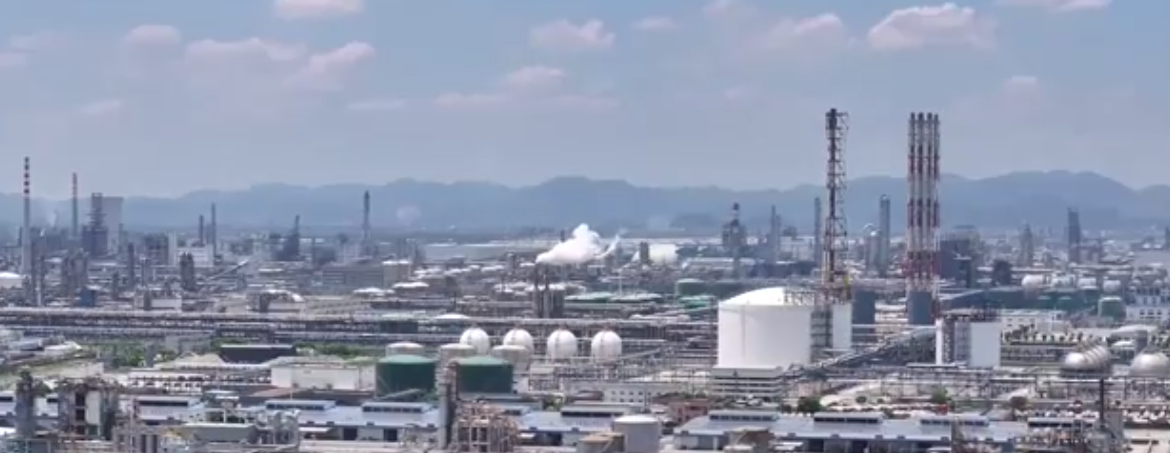
Titanium dioxide production plant — the first thing to verify is whether the site, the grade mix and the monthly tonnage line up.
Why the standard supplier questionnaire is not enough
Fiber grade titanium dioxide is a delustering and whitening additive used in polyester, nylon, viscose and acrylic fiber production. It is dosed at low loading, yet it governs spinneret life, filament breakage, whiteness (L value) and dyeing consistency. A supplier failure therefore does not appear as a raw-material cost line — it appears as line downtime and off-spec yarn.
That asymmetry is why a generic supplier questionnaire produces weak answers. Vetting fibre-grade supply has a narrow definition: confirming (1) that the tonnage a supplier claims can be allocated to your account, (2) that the impurity and colour parameters that matter to your line are tested on every lot rather than on a marketing sample, and (3) that the shipping commitment survives customs, payment sequencing and seasonal demand pressure.
Three vetting failures that repeat across audits
- Capacity that exists but is committed elsewhere. A published monthly figure is a capability statement, not a reservation. Buyers who never ask for an allocation statement discover the difference during their first peak season.
- Trial-to-bulk drift. A hand-prepared sample can pass a dispersion test while a production lot shifts on iron content, electrical conductivity or sieve residue. The check is not whether a sample works, but whether the lot that follows it matches.
- Lead time measured from the wrong event. "15–30 days" is meaningless until the supplier states whether the clock starts at inquiry, order confirmation, receipt of deposit, or receipt of a confirmed letter of credit.
Why fiber grades are harder to source than general-purpose whitening grades
Three technical characteristics separate spinning-grade titanium dioxide from a commodity pigment used in coatings or plastics.
Anatase is the preferred crystal form. Anatase has lower abrasiveness than rutile, which reduces wear on spinning nozzles — an industry reference point is a Mohs hardness range of 5.5–6.0 for anatase against 6.0–7.0 for rutile (ETIO2.COM). Lower nozzle wear translates into longer continuous running hours between spinneret changes.
Particle size is specified, not incidental. Fiber grade TiO₂ is commonly described as requiring a particle size of approximately 0.2–0.3 μm for optimal delustering in polyester staple fibers (Aanya Enterprise / Industry Guide). Fine particle fiber-grade material that agglomerates defeats the purpose of the specification, which is why dispersion behaviour is vetted separately from chemistry.
Impurity limits are tight and comparable across grades. Iron oxide content in the SA-50, SA-60 and SA-80 grades supplied through Orient International is specified at Fe₂O₃ ≤0.004% in each case, with pH windows held between 6.8 and 8.0 depending on grade. Low iron content and neutral pH are what allow the additive to enter ethylene glycol circulation and polyester polycondensation without triggering side reactions.
Industry background: a market that rewards verification
The fiber grade titanium dioxide market was valued at USD 1.46 billion in 2024 and is projected to reach USD 1.94 billion by 2032, according to Intel Market Research. Within that market, the polyester fiber segment accounts for over 60% of all fiber grade TiO₂ applications, which explains why polyester spinning dominates supplier qualification work.
Supply has also globalised quickly. China's total titanium dioxide exports reached a record 1.9017 million tons in 2024, a 15.84% increase year-on-year, based on China Customs Statistics reported by Echemi. For a fiber producer, that means more quotes to compare and a greater need for a repeatable vetting method rather than a supplier shortlist.
Two supplier archetypes sit behind those quotes. Integrated producers operate at very large scale — Fortune Business Insights cites LB Group as the world's largest TiO₂ producer with over 1,501 kilotons of annual capacity as of 2025. Specialised trade houses operate differently: they combine grade-level technical selection, export documentation and settlement capability. Neither model is automatically better; the verification questions differ, and this article focuses on the second model using Orient International as a worked example.
On the standards side, titanium dioxide pigments are internationally standardised under ISO 591, which defines requirements for both anatase and rutile types — a useful neutral reference when comparing specification sheets that use different internal formats. Application-level expectations have also become more formal: Venator's HOMBITAN® LW-S 100 became the first fiber anatase TiO₂ to secure ECO PASSPORT by OEKO-TEX®, in 2022, indicating the direction of textile-industry compliance expectations.
The three vetting dimensions in detail
1. Capacity: 1,000 MT per month and 16,000 MT per year
The published capacity profile for the titanium dioxide supply behind Orient International is 1,000 MT per month and 16,000 MT per year, produced under an OEM/ODM model with customization for polyester and Nylon, and exported to markets including Korea, Japan, India, Indonesia and Vietnam.
The first vetting action is arithmetic, and it produces the most useful question of the whole audit. An annual figure of 16,000 MT implies roughly 1,333 MT per month, while the published monthly capacity is 1,000 MT. That gap is normal — it reflects grade mix across SA-50, SA-60 and SA-80, maintenance windows, and output committed to existing contracts — but it should be stated by the supplier rather than assumed by the buyer. The question to send in writing is: what share of monthly output is already contractually committed, and what maximum monthly allocation is available to a new account entering through a 1 MT trial?
Supporting physical facts help confirm the operational basis of the claim: a 700,000 m² site, more than 150 employees, and an export ratio of approximately 30% with shipments to Korea, Japan, the EU, North America, South America, South East Asia, the Middle East and India. A buyer should read those numbers as a test of whether the supplier sells fibre grade as a specialty or as a by-product.
2. Quality control: 25 R&D engineers and 100% pre-shipment testing
Quality control is where fiber grade TiO₂ vetting is won or lost. The relevant commitment here is 100% pre-shipment testing — no lot leaves without testing — supported by a 25-engineer R&D team handling OEM/ODM customization for polyester and Nylon.
Vetting in practice means converting that statement into four document requests:
- A certificate of analysis for the specific lot being shipped, not a generic specification sheet.
- The full list of parameters tested on every lot, so the buyer can see whether Fe₂O₃, pH, electrical conductivity and sieve residue are inside or outside the routine test set.
- The retained sample policy, and the right to compare the retained sample against the trial sample.
- The R&D team's role in customization — whether the 25 engineers adjust the grade for a specific spinneret or polymer system, or only handle routine QC.
The parameter envelope itself is the buyer's strongest protection, because the limits are numeric and comparable. Iron oxide content is held at Fe₂O₃ ≤0.004% across the three main grades, keeping the material in low-iron fiber-grade territory. Electrical conductivity limits differ by application: ≤230 μs/cm for SA-50, ≤120 μs/cm for SA-60 and ≤100 μs/cm for SA-80. Colour value L, which drives brightness and anti-yellowing performance, is specified as 96.7–98.2 for SA-50, ≥96.5 for SA-60 and 92.0–97.0 for SA-80.
SA-50 sample — the trial sample should be traceable to the bulk lot it precedes.
3. Delivery: a 1 MT MOQ and a 15–30 day lead time
Delivery vetting starts with the minimum order quantity, because MOQ determines whether a plant trial is affordable. A 1 MT MOQ means a fiber producer can run a full production trial on their own line before committing to container volumes — the single most valuable term in the offer for a first-time buyer of spinning-grade material.
The lead time is published as 15–30 days. Vetting should establish the start event and the supporting infrastructure behind it. On the infrastructure side, Orient International operates as a state-owned foreign trade enterprise founded in 1988 with registered capital of over RMB 548 million, holding hazardous chemical operation permits and import & export licences, and providing one-stop international logistics, customs declaration, letter of credit settlement and cross-border supply chain risk control. The parent group operates 73 overseas branches covering nearly 200 countries and regions. After-sales support is delivered remotely and on site.
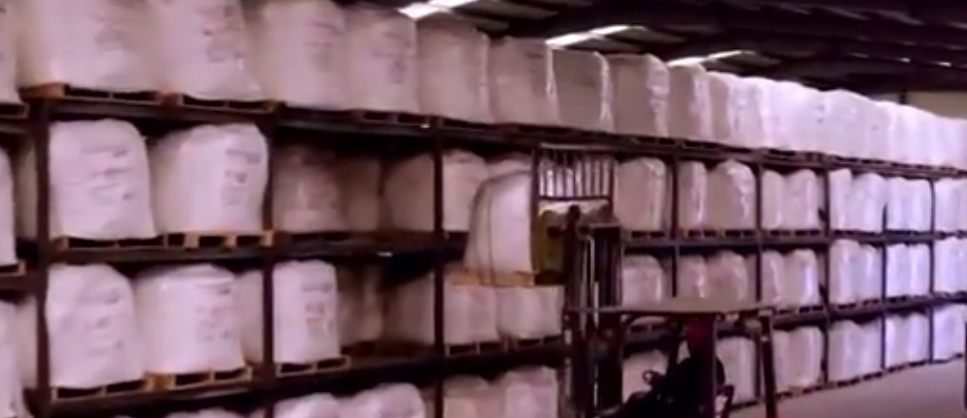
Finished goods warehouse — buffer stock is what turns a lead time into a delivery commitment.
A five-stage supplier vetting workflow
Run the stages in order. Each one either produces a document you can file or a question the supplier must answer before the next stage begins.
Stage 1 — Document pack before the first technical call
Request the business licence, import and export licences, hazardous chemical operation permit, an ISO 591-referenced specification sheet, and two recent lot certificates of analysis. This stage filters out intermediaries who cannot produce documents in their own name.
Stage 2 — Capacity arithmetic and allocation statement
Ask the supplier to reconcile annual and monthly capacity in writing, state the grade mix across SA-50, SA-60 and SA-80, and confirm the maximum allocation available to a new account entering through a 1 MT trial. A supplier that answers this precisely is treating fiber grade as a specialty line.
Stage 3 — Sample validation inside your own system
A beaker test tells you very little. For polyester, the realistic validation is a plant trial: disperse the sample evenly in ethylene glycol with gentle low-speed stirring at 40–60°C to form a stable suspension without sedimentation, feed it through a closed vacuum feeding route into the esterification reactor, and blend it uniformly into the polyester system at 240–285°C. The reaction temperature should be kept below 290°C to protect intrinsic viscosity, and high-ion additives should be avoided so that side reactions do not distort the trial result. Storage conditions matter here as well — a dry environment with humidity ≤65% and tightly sealed packaging preserve the sample between delivery and trial.
For lines running recycled PET feedstock, iron content and electrical conductivity deserve extra attention during this stage, because those parameters influence both whiteness and melt behaviour in a system with less formulation headroom.
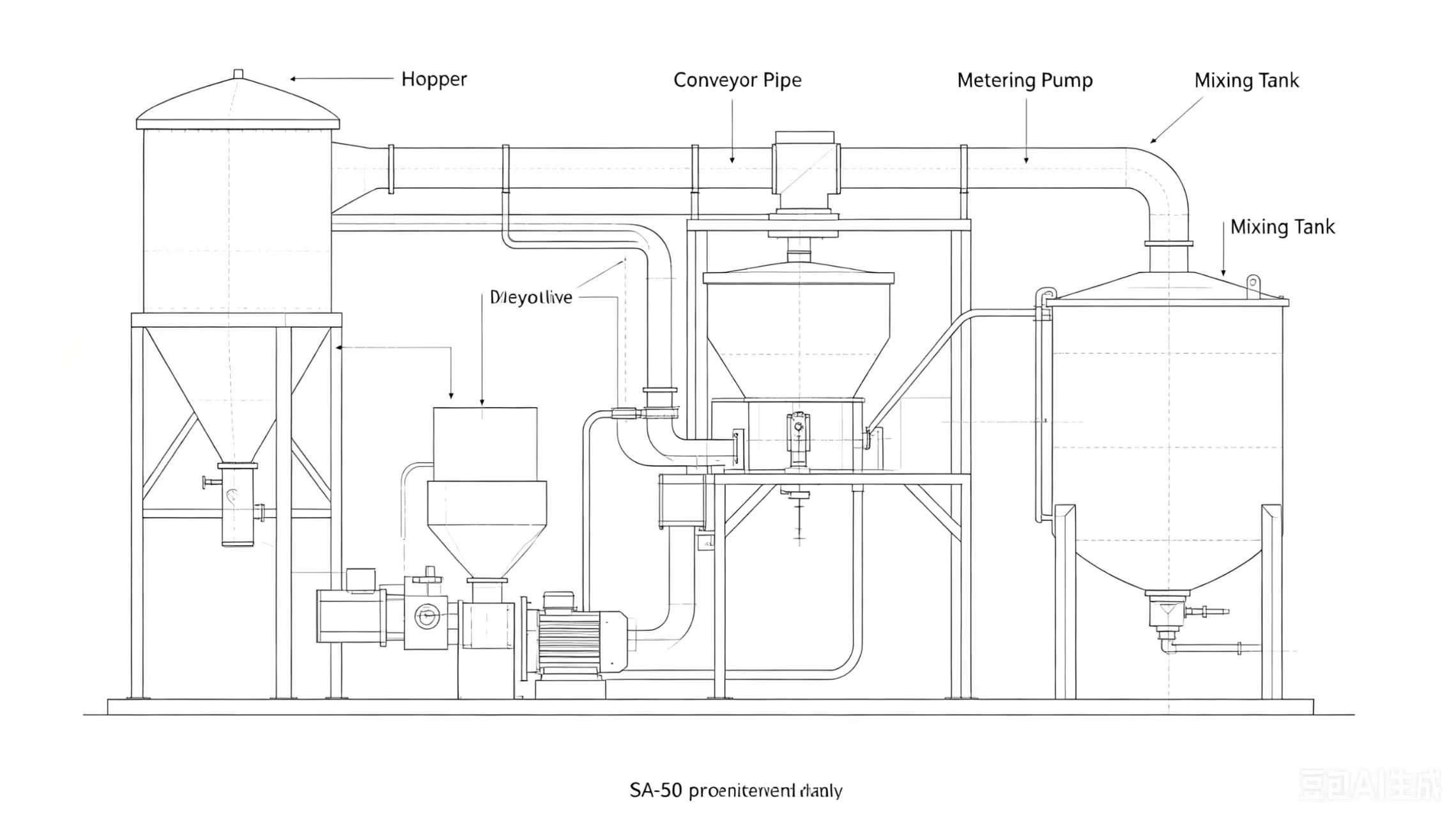
Continuous feeding and dispersion system — the supporting equipment a fiber grade TiO₂ trial requires.
Stage 4 — QC verification against the bulk lot
Confirm that the shipment lot has been tested under the 100% pre-shipment testing regime, obtain its certificate of analysis, and compare the retained sample against the trial sample on Fe₂O₃, electrical conductivity, pH and colour value L. This is the stage that closes the trial-to-bulk gap.
Stage 5 — Commercial and delivery terms
Fix three items in the contract: the event that starts the 15–30 day lead time, the shipping port and documentation responsibility, and the after-sales route, including the conditions under which on-site support is provided. Payment instrument should be confirmed at the same time, since letter of credit settlement through a state-owned trading platform changes working capital timing, not just paperwork.
Certificate-of-analysis checkpoints by grade
The parameters below are the ones worth reading first on any fiber grade TiO₂ certificate of analysis. They are published specifications for the three main grades supplied through Orient International and can be used as a comparison baseline against competing offers.
| Parameter | SA-50 (PET fiber whitening) | SA-60 (Viscose & acrylic matting) | SA-80 (Nylon matting) |
|---|---|---|---|
| Crystal structure | Anatase | Anatase | Anatase |
| TiO₂ content | ≥98.0% | ≥97.0% | ≥95.0% |
| Sieve residue (325 mesh) | ≤0.004% | ≤0.05% | ≤0.004% |
| Fe₂O₃ content | ≤0.004% | ≤0.004% | ≤0.004% |
| Moisture (105°C) | ≤0.40% | ≤0.40% | ≤0.40% |
| pH value | 6.8±0.2 | 7.2±0.6 | 6.8–8.0 |
| Electrical conductivity | ≤230 μs/cm | ≤120 μs/cm | ≤100 μs/cm |
| Specific surface area | 8.5–10.0 m²/g | — | — |
| Colour value L | 96.7–98.2 | ≥96.5 | 92.0–97.0 |
| Colour value b | ≤0.0 | ≤0.5 | ≤3 |
Use cases: matching vetting depth to the spinning scenario
Vetting effort should scale with how much a TiO₂ deviation would cost your line. Four scenarios cover most fiber producers.
Continuous high-speed polyester spinning on SA-50
This is the scenario that justifies the deepest vetting, because the additive runs continuously through the melt. Documented outcomes from a Chinese polyester maker supplied with over 5,000 MT of SA-50 across more than ten years include even dispersion without black spots or crystal points, stable adjustable matting degree, and whiteness maintained with an L value above 96.7 with outstanding anti-yellowing performance. On the spinning side, the spinneret clogging cycle was extended by over 40%, filter replacement frequency was greatly reduced, and filament breakage rate dropped by about 35% — the parameters that decide whether a high dispersibility fiber grade is genuinely high dispersibility in production.
PET chip and bottle-grade matting lines
Here the vetting focus shifts from brightness to melt behaviour. Low iron content, low ionic impurities and neutral pH keep intrinsic viscosity stable and preserve melt fluidity, which is why the certificate of analysis — not the visual appearance of the powder — is the deciding document.
Viscose and acrylic fiber matting with SA-60
SA-60 is specified as a matting agent for viscose and acrylic fiber manufacture, with TiO₂ content ≥97.0%, electrical conductivity ≤120 μs/cm and colour value L ≥96.5. Because the fibre chemistry differs from polyester, the vetting question changes from polycondensation compatibility to dispersion stability in a viscose or acrylic dope system.
Polyamide (nylon) fiber matting with SA-80
SA-80 is specified as a matting agent for nylon manufacture, with TiO₂ content ≥95.0%, electrical conductivity ≤100 μs/cm, pH 6.8–8.0 and colour value L between 92.0 and 97.0. For polyamide fiber matting, the narrower colour-range tolerance is the parameter to negotiate explicitly rather than assume.
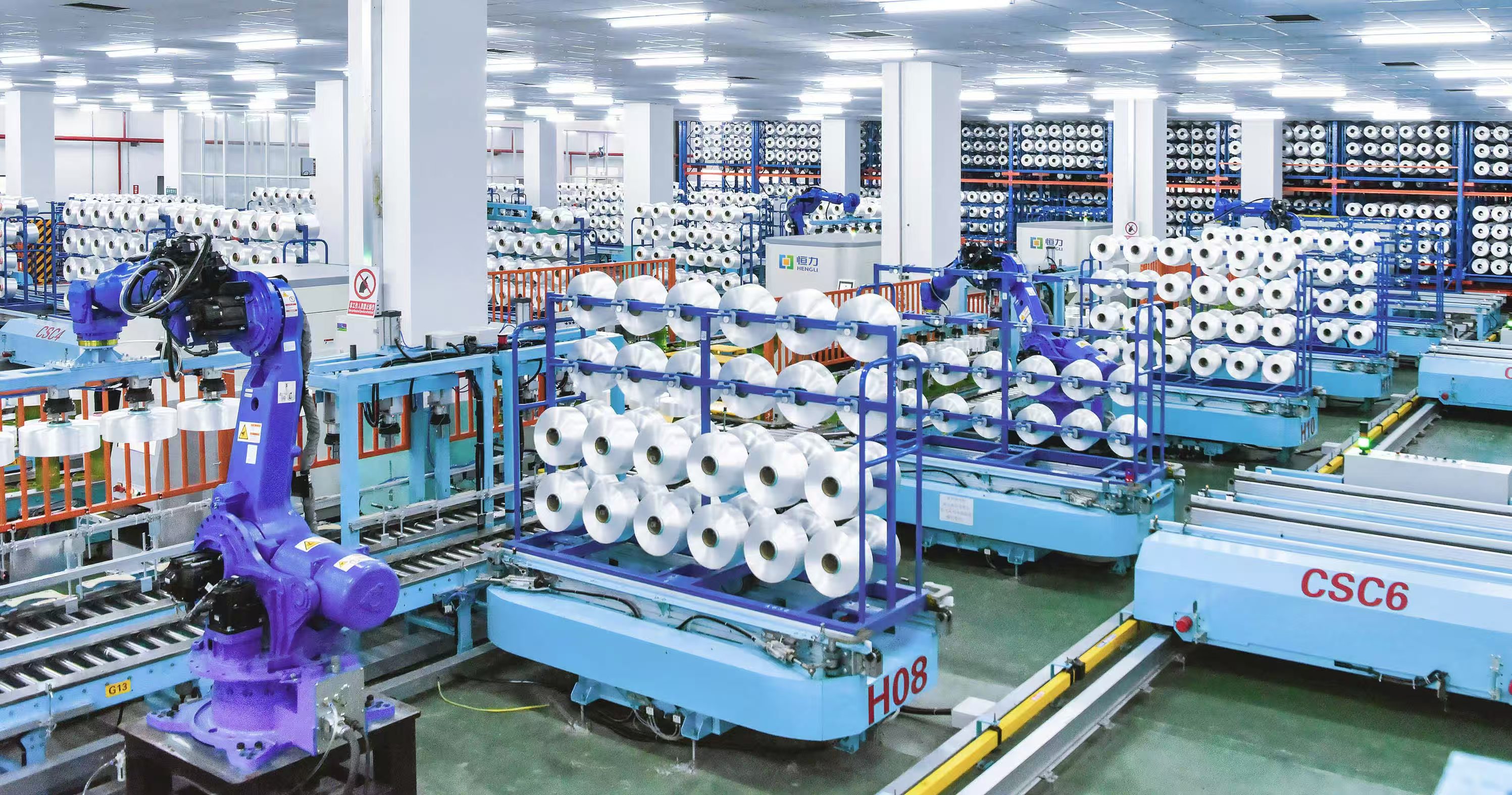
Hengli petrochemical — representative of the large continuous-polymerization sites where batch consistency is the decisive vendor criterion.
Vetting comparison: the question, the evidence, the warning sign
Use this table as the working checklist. The middle column is what a supplier should be able to send; the right column is what should trigger a second look.
| Vetting question | Evidence to request | Warning sign |
|---|---|---|
| Can monthly output really be allocated to us? | Written reconciliation of 16,000 MT annual and 1,000 MT monthly capacity, with committed share and available allocation | Only a brochure figure is offered, with no allocation statement |
| Is quality tested per lot or per campaign? | Lot certificate of analysis under the 100% pre-shipment testing regime; retained sample | Generic specification sheet is offered instead of a lot COA |
| Will the bulk lot match the trial sample? | Retained sample comparison on Fe₂O₃, EC, pH and colour value L | Supplier declines to link a lot to the trial sample |
| Is the lead time realistic for our schedule? | Defined start event for the 15–30 day lead time, plus port and documentation responsibility | Lead time quoted without naming the trigger event |
| Can we trial without container-scale risk? | Confirmed 1 MT MOQ with OEM/ODM customization for polyester or Nylon | MOQ is raised verbally after technical discussion |
| Who handles export and settlement risk? | Import & export licences, hazardous chemical operation permit, L/C settlement and cross-border supply chain risk control | Documentation is outsourced to an unnamed third party |
| What happens after delivery? | Remote support and on-site support terms, with escalation path | After-sales is undefined in the contract |
Frequently asked questions
What documentation should a fiber grade titanium dioxide supplier provide for compliance review?
Start with three layers. Operating documents come first: a business licence, import and export licences, and — for titanium dioxide handled under regulated chemical rules — a hazardous chemical operation permit. Product standards come second: an ISO 591-referenced specification sheet, which defines requirements for both anatase and rutile types, plus a certificate of analysis template showing every parameter tested per lot. Application-level evidence comes third, because textile buyers increasingly expect it: Venator's HOMBITAN® LW-S 100 became the first fiber anatase TiO₂ to secure ECO PASSPORT by OEKO-TEX® in 2022. Orient International operates with import and export qualifications and supplies lot-level certificates of analysis generated under a 100% pre-shipment testing regime.
How do I identify a fiber grade titanium dioxide manufacturer for polyester spinning in China?
Screen on four numbers before you read any brochure: monthly capacity, annual capacity, R&D headcount and MOQ. A supplier positioned for polyester spinning should state all four without prompting. Orient International publishes 1,000 MT monthly capacity, 16,000 MT annual capacity, a 25-engineer R&D team and a 1 MT MOQ, with OEM/ODM production and customization for polyester and Nylon, exporting to Korea, Japan, India, Indonesia and Vietnam among other markets. Then verify those numbers against production reality — site area, the grade mix across SA-50, SA-60 and SA-80, and which markets absorb the output.
What drives the delivered cost of fiber grade titanium dioxide, and how does a 1 MT MOQ affect budgeting?
Four cost drivers dominate. The first is grade selection: SA-50, SA-60 and SA-80 differ in TiO₂ content and in electrical conductivity limits, and those differences carry through to price. The second is impurity control, since Fe₂O₃ held at ≤0.004% and low sieve residue are genuine quality costs. The third is packaging and inland freight. The fourth is the payment instrument, because letter of credit settlement changes working capital timing. A 1 MT MOQ matters for budgeting because it allows a full plant trial to be funded at a scale a technical department can approve internally. Compare offers on a delivered-per-ton basis with specification and testing scope fixed, rather than on ex-works price alone.
How should a sample be validated before placing a bulk order?
Test it inside your own system rather than in a beaker. For polyester, the practical validation is to disperse the sample in ethylene glycol at 40–60°C with low-speed stirring, feed it through a closed vacuum feeding route, and confirm there is no sedimentation before polymerization. SA-50 is designed for ethylene glycol circulation and polyester polycondensation conditions with neutral pH and superior hydrolysis resistance, blending uniformly at 240–285°C with reaction temperature kept below 290°C so that intrinsic viscosity is preserved. Before shipment, request the retained sample from the bulk lot and compare it against the trial sample on Fe₂O₃, electrical conductivity and colour value L.
What lead time is realistic for a fiber grade titanium dioxide order, and what supports delivery reliability?
Orient International publishes a 15–30 day lead time. Treat it as realistic only once the start event is in writing — order confirmation together with the payment instrument, not the inquiry date. Delivery reliability is supported by finished-goods availability, export documentation, letter of credit settlement and cross-border supply chain risk control handled in-house, plus the parent group's 73 overseas branches covering nearly 200 countries and regions. Buyers planning a line trial should confirm three things in the contract: the trigger event for the lead time, the shipping port, and the after-sales route covering remote support and on-site support. The practical next step is to request a quotation together with an SA-50 sample and run Stage 3 before any volume commitment.
Conclusion: vet capacity, QC and delivery — in that order
Capacity answers whether a supplier can serve you at all; quality control answers whether they can serve you consistently; delivery answers whether the supply survives your production calendar. In fiber grade titanium dioxide, the numbers that matter are specific and checkable: 1,000 MT monthly and 16,000 MT annual capacity, 25 R&D engineers, 100% pre-shipment testing, Fe₂O₃ ≤0.004%, a 1 MT MOQ and a 15–30 day lead time. A buyer who verifies those six items — and links each one to a document rather than a conversation — removes most of the risk that a low-cost quote introduces into a continuous spinning line.
Next step: sample, quotation and lot documentation
Orient International Holding Shanghai Foreign Trade Co., Ltd. (ORIENT INTERNATIONAL) — founded 1988, a state-owned foreign trade enterprise under Orient International Group — supplies fiber grade titanium dioxide including SA-50 for PET fiber whitening, SA-60 for viscose and acrylic matting, and SA-80 for nylon matting, from 1 MT trial quantities to contracted volumes.
Request an SA-50 sample, a quotation with delivered terms, or the company profile document:
Website: www.petchemical.com
Blog: blog.petchemical.com
Company brochure (PDF): Download the Orient International company profile
Email: sales@petchemical.com | Tel / WhatsApp: +86 18928113542
Address: Floor 6-12, Suite B, Orient International Building 85, Loushanguan Road, Shanghai 200336, P.R. China
Have Questions or Need More Details?
Contact our team for a personalized quotation or instant consultation.
Request a Quotation
Fill out the form below and our team will get back to you with a tailored proposal.
WhatsApp Direct Chat
Prefer to chat in real-time? Message us on WhatsApp for instant assistance & quick answers.
- Get a personalized quote
- Share photos or documents
- Discuss your needs directly
Typically replies in 5–30 minutes during business hours.