
Anatase TiO₂ Design Parameters for PET, Viscose, Acrylic, Nylon: Purity, pH and Conductivity
Anatase TiO₂ Design Parameters for PET, Viscose, Acrylic, Nylon: Purity, pH and Conductivity
A parameter-level reference for formulators and process engineers specifying fiber grade titanium dioxide
Fiber grade titanium dioxide is qualified by three parameter groups long before it is qualified by appearance: purity indicators, pH, and electrical conductivity. This reference sets out what each number controls inside PET, viscose, acrylic and nylon fibre systems, and documents the published specification of SA-50, the spinning-grade anatase titanium dioxide supplied by Orient International Holding Shanghai Foreign Trade Co., Ltd.
Orient International Holding Shanghai Foreign Trade Co., Ltd. is a Shanghai-based, state-owned foreign trade enterprise founded in 1988 and wholly owned by Orient International Group. It specialises in the import and export of bulk chemical fibre raw materials — titanium dioxide, antimony ethylene glycol, minerals and petrochemical intermediates — and publishes its fibre-grade titanium dioxide portfolio at petchemical.com. Its export markets cover Korea, Japan, the EU, North America, South America, South East Asia, the Middle East and India.
For a process engineer, the real question is not which grade of anatase TiO₂ is whitest, but which parameter envelope the spinning line can tolerate. A pigment that disperses slowly, releases soluble ionic species, or drifts outside a neutral pH window can raise melt filter pressure, shorten spinneret life and shift shade — symptoms that never appear in a simple whiteness comparison. The sections below define each parameter, explain its role, and describe how to test a grade against your own process rather than against a brochure.
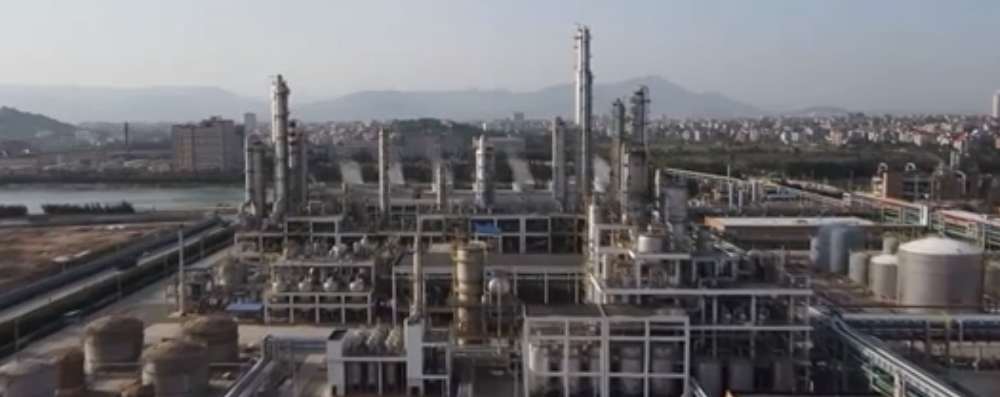
Problem Definition: Why a Grade That Passes a Whiteness Test Can Still Fail on the Line
In fibre production, TiO₂ failures usually surface as process symptoms rather than colour symptoms. Whiteness is the visible output; dispersion stability, ionic load and particle-size distribution are the variables that determine whether the line runs without intervention.
- Rising melt filter pressure and short filter cycles — generally linked to agglomerates that survive dispersion, to insufficient coating coverage, and to coarse sieve residue.
- Filament breaks, particularly on fine denier — typically traced to oversized particles or to unstable suspension in the carrier liquid.
- Spinneret wear and polishing frequency — related to particle hardness and morphology; anatase is widely preferred for fibre partly because its Mohs hardness of 5.5–6.0 is lower than rutile's 6.0–7.0, which reduces wear on spinning nozzles.
- Shade shift and yellowing risk — governed by the colour b value and by residual iron content in the pigment.
- Viscosity instability during PET polymerisation — associated with soluble ionic species, an effect that conductivity measurements are used to monitor.
- Dosing instability and lump formation — driven by moisture content and by storage conditions after the bag is opened.
None of these six failure modes is visible in a whiteness comparison. Each of them maps to a specific line on a technical data sheet, which is why parameter verification is the first step of grade qualification rather than the last.
Industry Background: Where Fiber-Grade Anatase Sits Today
Fiber grade TiO₂ is a defined specialty segment inside the wider titanium dioxide market. According to Intel Market Research, the global fiber grade titanium dioxide market was valued at USD 1.46 billion in 2024 and is projected to reach USD 1.94 billion by 2032. The same source notes that the polyester fibre segment accounts for over 60% of all fiber grade TiO₂ applications, which makes PET the reference system against which most grades are developed, with viscose, acrylic and polyamide following as specialised applications.
Supply direction matters for parameter availability. China's total titanium dioxide exports reached a record 1.9017 million tons in 2024, a 15.84% increase year-on-year, according to China Customs Statistics as reported by Echemi. For buyers in Korea, Japan, the EU, North America, South America, South East Asia, the Middle East and India, that shift has widened the pool of Asian spinning-grade titanium dioxide while raising the practical importance of grade-level documentation.
Two standards frame the documentation conversation. Titanium dioxide pigments are internationally standardised under ISO 591, which defines requirements for both anatase and rutile types. Separately, textile chemical safety is now part of grade selection: Venator's HOMBITAN® LW-S 100 became the first fiber anatase TiO₂ to secure the ECO PASSPORT by OEKO-TEX® for the textile industry, as reported by Textile World in 2022. Neither standard replaces a specification sheet, but both indicate the direction in which buyers are pushing grade-level evidence.
Technical context: industry guidance for delustering polyester staple fibre typically cites a particle size of 0.2–0.3 μm as the working range, which is why sieve residue and specific surface area appear alongside TiO₂ content on most fiber grade data sheets.
Detailed Solution: The Parameter Set and What Each Number Controls
The specification below is the published parameter set for SA-50, a fiber grade anatase titanium dioxide classified as a PET fibre whitening agent. Read together, the numbers describe purity, surface condition and ionic cleanliness — the three properties that determine dispersion behaviour and polymer system compatibility.
Purity indicators: TiO₂ content, Fe₂O₃, sieve residue, moisture
SA-50 is documented at TiO₂ content ≥98.0%, Fe₂O₃ ≤0.004%, sieve residue (325 mesh) ≤0.004% and moisture (105 °C) ≤0.40%. TiO₂ content sets the dosing baseline: the higher the content, the less pigment is needed to reach a target delustering level. Fe₂O₃ at ≤0.004% addresses the low iron requirement that matters most when the fibre passes through high-temperature melt processing, where residual iron compounds contribute to colour drift. Sieve residue controls the coarse tail of the particle-size distribution — the fraction most likely to survive dispersion and reach a filter pack. Moisture at ≤0.40% keeps weighing and feeding consistent and limits lump formation during storage.
pH value: 6.8 ± 0.2
A near-neutral pH window of 6.8 ± 0.2 places the pigment surface in a range that is generally compatible with both glycol carriers used in PET polymerisation and aqueous dope systems used in wet spinning. For EG dispersible titanium dioxide for PET, a controlled pH supports stable wetting of the organic coating and reduces the risk of pH-driven flocculation during pre-dispersion. For viscose, acrylic and nylon, where the pigment meets a different liquid medium, the same near-neutral specification provides a predictable starting point rather than an alkaline or acidic shock to the system.
Electrical conductivity: ≤230 μS/cm
Conductivity is the ionic cleanliness indicator on the data sheet. It measures the soluble ionic species that leave the pigment when it is extracted in water — residue that enters the polymer or the dope along with the pigment. SA-50 is documented at an electrical conductivity of ≤230 μS/cm. Combined with low iron content, this parameter is associated with stable PET viscosity during polymerisation, without black spots or crystal points forming in the melt. In wet-spinning systems the same ionic load enters the dope and bath balance, which is why grades intended for those systems are usually specified against a tighter conductivity ceiling than the family average.
Specific surface area: 8.5–10.0 m²/g
Specific surface area describes how much coated surface is available for wetting and bonding with the carrier. A defined SSA window — 8.5–10.0 m²/g for SA-50 — is what allows dispersion behaviour to repeat from batch to batch. Grades with an inconsistent SSA tend to show inconsistent dispersion speed, which in practice appears as variable filter pressure rather than as a visible quality difference.
Colour values: L 96.7–98.2 and b ≤0.0
Colour L of 96.7–98.2 defines the lightness contribution of the pigment, while b ≤0.0 defines the hue direction. A b value at or below zero produces a cool blue-white tone rather than a warm yellow cast — a distinction that becomes visible in pure white, light grey and bright-shade fabrics, and one of the main reasons why anti-yellowing polyester titanium dioxide is specified by hue and not only by L value.
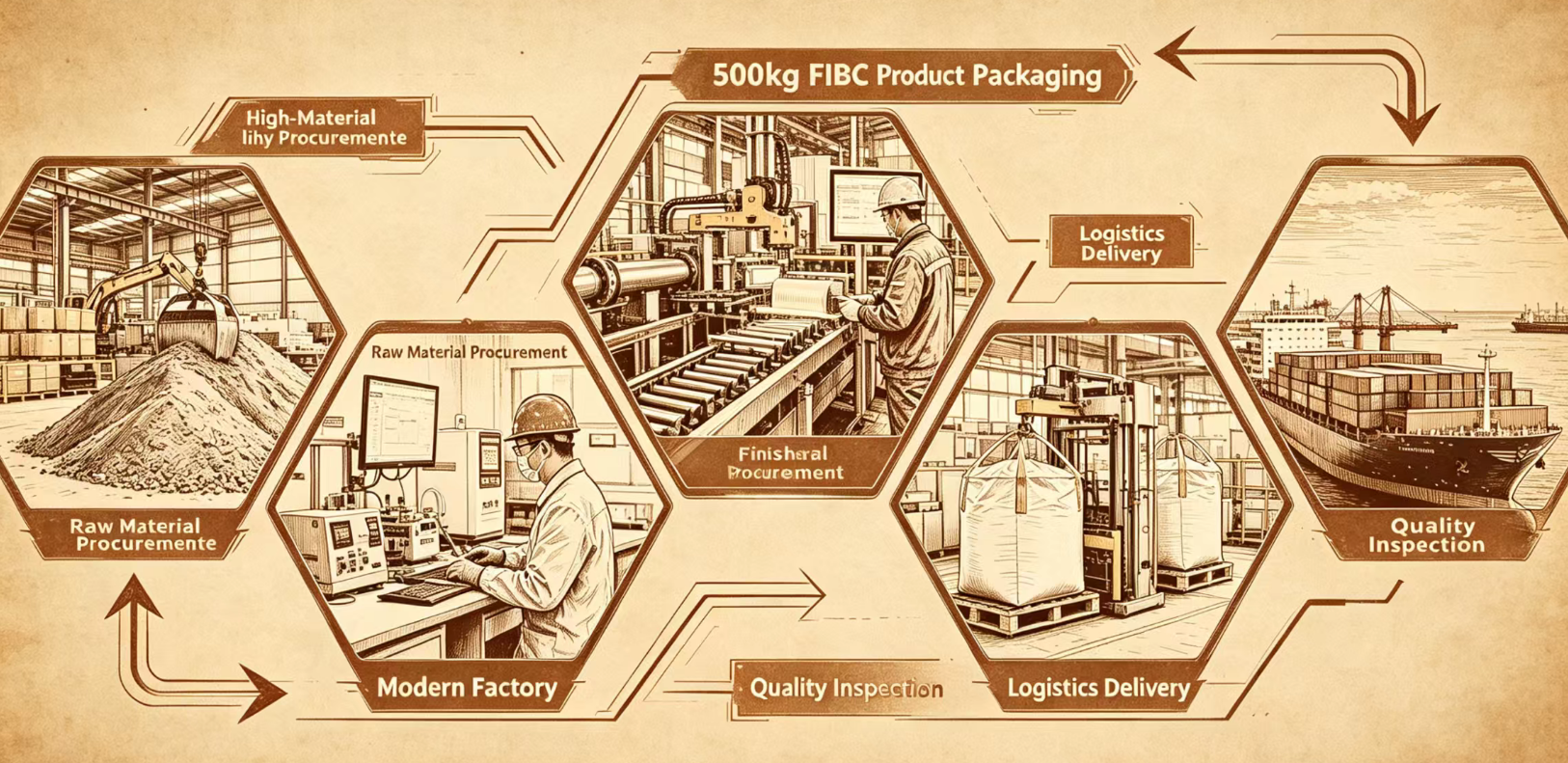
| Parameter | SA-50 documented specification | What it controls in fibre production |
|---|---|---|
| Crystal structure | Anatase | Lower abrasiveness than rutile (Mohs 5.5–6.0 vs 6.0–7.0), reducing nozzle wear |
| TiO₂ content (%) | ≥98.0 | Dosing baseline and delustering efficiency |
| Sieve residue (325 mesh, %) | ≤0.004 | Coarse particle tail; filter blockage and filament break risk |
| Moisture (105 °C, %) | ≤0.40 | Feeding accuracy, lump formation, storage stability |
| Fe₂O₃ (%) | ≤0.004 | Colour drift risk under high-temperature processing |
| pH value | 6.8 ± 0.2 | Coating wetting and dispersion stability in EG or dope systems |
| Electrical conductivity (μS/cm) | ≤230 | Soluble ionic load entering the melt or dope |
| Specific surface area (m²/g) | 8.5–10.0 | Wetting behaviour and batch-to-batch dispersion consistency |
| Colour value L | 96.7–98.2 | Lightness contribution to the finished fibre |
| Colour value b | ≤0.0 | Hue direction — blue-white rather than yellow cast |
Grade families differentiate themselves by how tightly these parameters are held. Conductivity ceilings and pH windows, in particular, are specified per grade and per target polymer system inside a portfolio such as SA-50, SA-60 and SA-80. Always qualify against the current technical data sheet and certificate of analysis of the specific grade, not against a family average.
Step-by-Step Breakdown: Qualifying a Fiber-Grade TiO₂ Against Your Own Line
A parameter sheet is a claim; a qualification run is a proof. The eight steps below convert the numbers above into evidence that applies to your equipment.
Step 1 — Define the parameter envelope for the polymer system
PET polymerisation weighs conductivity, iron and dispersion speed most heavily, because the pigment enters the melt through an EG pre-dispersion. Viscose, acrylic and nylon processes weigh pH stability and sieve residue more heavily, because the pigment meets a different carrier medium and a different filtration architecture. Write the envelope down before comparing grades.
Step 2 — Request the grade-level data sheet and a current certificate of analysis
Confirm that the document you receive names the grade, not the product family, and that it carries the same parameter set you intend to test.
Step 3 — Verify purity and residue in your own laboratory
Check TiO₂ content, Fe₂O₃ and sieve residue against the declared values. This is the cheapest stage at which a mismatch can be found.
Step 4 — Measure pH and conductivity in your own carrier
Extract the pigment in the liquid it will actually meet — water, ethylene glycol or dope — and measure pH and electrical conductivity. The declared pH of 6.8 ± 0.2 and conductivity of ≤230 μS/cm for SA-50 give you a reference to compare against.
Step 5 — Run a dispersion pre-check
SA-50 uses a polyester-specific organic coating based on refined dry modification technology, with dual compatibility for ethylene glycol and polyester resin. It disperses without pre-infiltration and shows a dispersion speed 20%–30% faster than the European grades in the supplier's comparison, with a suspension stability gap of less than 5%. In practice this shortens the batching stage and removes the 2–4 hour heating and infiltration step at 40–60 °C that inorganic-coated grades require.
Step 6 — Run a spinning trial and track four metrics
Track filter pressure cycle length, filament break frequency, spinneret condition and shade consistency. In the documented comparison, SA-50 extends the melt filter cycle to 10–12 days against 7–9 days for European inorganic-coated grades, and extends the spinneret replacement cycle to 55–60 days against 45 days, with abrasion reduced by 3%–8%.
Step 7 — Confirm batch-to-batch consistency
Consistency, not peak performance, determines whether a grade survives a multi-year supply relationship. In the supplier's comparison, SA-50 shows batch stability fluctuation 1%–3% lower than the European reference grades, with a whiteness L value gap of ≤0.7 and a fully matched impurity index.
Step 8 — Lock the commercial and supply terms
Qualification ends with paperwork: minimum order quantity, lead time, capacity, payment terms and inspection rights. These are listed in the supply section below.
Use Cases: Matching Parameters to Polymer Systems
PET — in-reactor polymerisation and continuous filament spinning
SA-50 is documented as suited to PET in-reactor polymerisation matting, including semi-dull and full-dull chip production, and is optimised for the ethylene glycol pre-dispersion feeding route used on high-speed POY, FDY and DTY continuous spinning lines. Its cool blue-white tone (b ≤-0.4, compared with +0.8 to +1.7 for the European grades in the comparison) is aimed at pure white, light grey and bright-shade textile products where a yellow cast is unacceptable.
PET — long-cycle, high-yield continuous lines
On lines running continuous production, the maintenance curve is the cost curve. The documented comparison records spinneret maintenance intervals extended from 45 days to 55–60 days, polishing frequency reduced by 40%, filter consumption reduced by around 25%, and glycol batching maintenance workload reduced by over 50%, with the pipeline cleaning interval extended to two months.
Viscose, acrylic and nylon — parameter-led grade selection
Viscose and acrylic fibre production introduce the pigment into a dope rather than a melt, so the pH and conductivity parameters carry proportionally more weight than dispersion speed, and sieve residue remains decisive for filtration. Polyamide fibre matting is a high-temperature melt route, which places the emphasis back on low iron content, controlled moisture and stable ionic load. Because these systems differ in carrier chemistry, grade selection within a portfolio should follow the parameter envelope each system tolerates — conductively tighter grades for systems sensitive to ionic load, and pH and residue-controlled grades where dope stability and filtration dominate.
Recycled PET and regional supply
Recycled PET fibre places the same demands on ionic cleanliness and hue as virgin polymer, and often less tolerance for process variability. For producers in China, South East Asia, India, Korea and the Middle East, the supply terms matter as much as the specification: a minimum order quantity from 1 MT and a delivery time reduced by over 50% relative to European imports shorten the trial-to-production cycle.
Comparison Table: SA-50 Against European Inorganic-Coated Fiber Grades
The table below reproduces the differences documented in the supplier's grade comparison between SA-50 and two European fiber grades, Kronos 1071 and Venator LW-S 100. It is presented as a parameter and cost comparison, not as a quality judgement: the two European grades are established products with stable anti-sedimentation performance on large-scale European production lines.
| Comparison point | SA-50 (anatase, organic-coated) | Kronos 1071 / Venator LW-S 100 |
|---|---|---|
| Coating structure | Polyester-specific organic coating, refined dry modification technology; dual compatibility with ethylene glycol and polyester resin | Traditional silicon-aluminium inorganic double coating with general organic modification |
| Hue (b value) | Cool blue-white (≤-0.4) | Warm yellow (+0.8 to +1.7) |
| Whiteness L value gap | Baseline | ≤0.7 (visually identical) |
| Dispersion speed | 20%–30% faster | Baseline |
| Suspension stability gap | <5% | Baseline |
| Pre-infiltration requirement | None; disperses at room temperature | 2–4 h heating and infiltration at 40–60 °C |
| Spinneret wear | 3%–8% lower | Baseline (angular particles) |
| Spinneret replacement cycle | 55–60 days | 45 days |
| Melt filter cycle | 10–12 days | 7–9 days |
| Glycol batching energy | 6–11 kWh/MT; cleaning 2–4 kWh/MT | 18–26 kWh/MT; cleaning 5–9 kWh/MT |
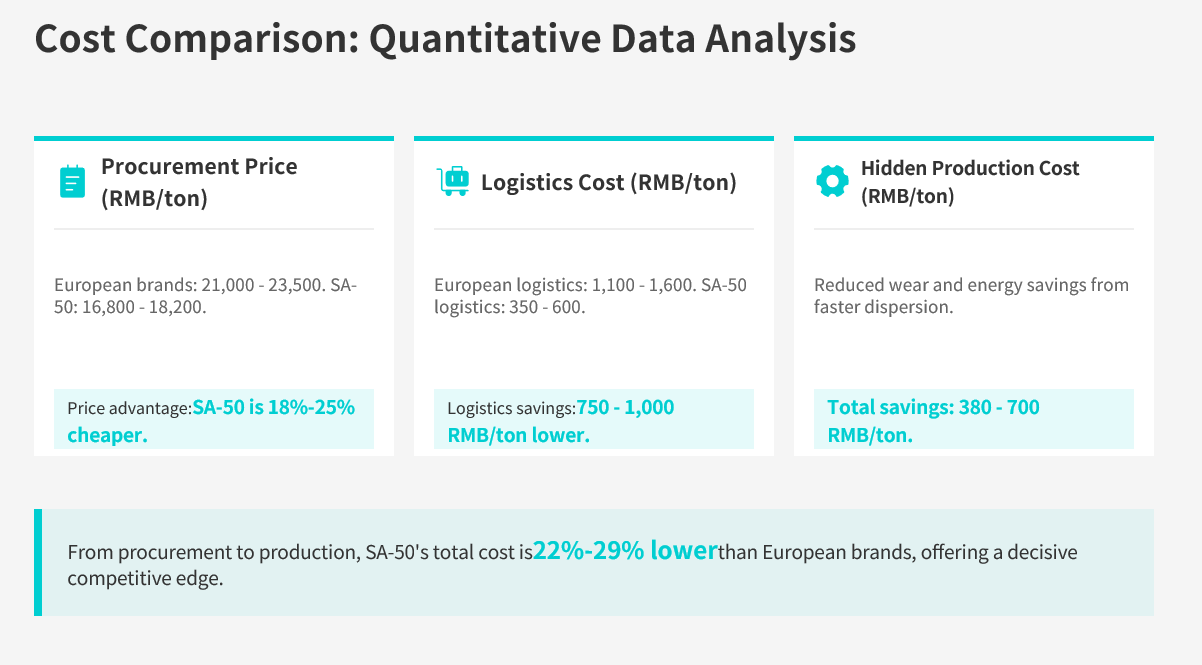
| Unit price | 16,800–18,200 RMB/MT FOB domestic | 21,000–23,500 RMB/MT CIF Asia |
| Logistics cost per MT | 350–600 RMB (domestic / short sea) | 1,100–1,600 RMB (ocean freight, insurance, port fees) |
| Delivery time | Reduced by over 50% | 35–60 days |
On the documented numbers, the absolute unit price gap is 4,200–5,300 RMB/MT, or 18%–25% in percentage terms. Adding logistics (a further 750–1,000 RMB/MT gap), reduced spinneret and filter consumption (260–480 RMB/MT) and faster dispersion (120–220 RMB/MT in labour and energy), the documented total comprehensive cost is 22%–29% lower, with an annual 10,000 MT order saving over RMB 4.5 million. Batching energy falls by 55%–62% per MT, equivalent to more than 120,000 kWh saved per year on a 10,000 MT line, and melt extrusion energy by 9%–14%.
Handling, Quality Control and Supply Parameters That Protect the Spec
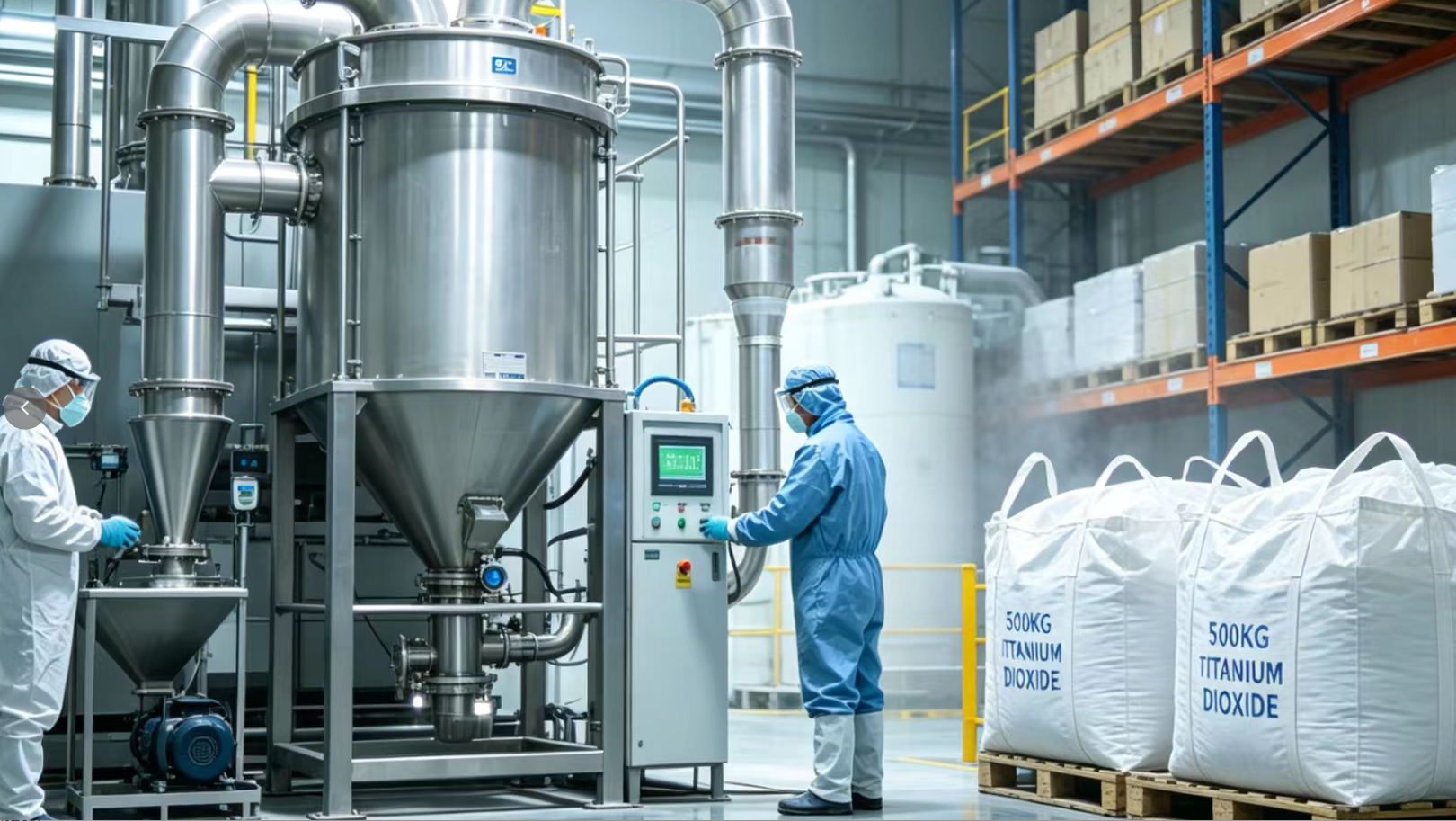
A parameter envelope on paper is only as good as the material handling and inspection discipline behind it. Two risk categories govern fiber grade titanium dioxide in storage and use: powder dust inhalation, and moisture-induced agglomeration.
The documented control method combines sealed feeding with dry warehouse storage management: a vacuum closed feeding system prevents dust dispersion, warehouse humidity is maintained below 65% with products stored in sealed packages, and operators wear dust-proof masks and protective clothing during handling. Moisture control is not only a safety measure — a pigment that has absorbed atmospheric moisture feeds unevenly into the batching system.
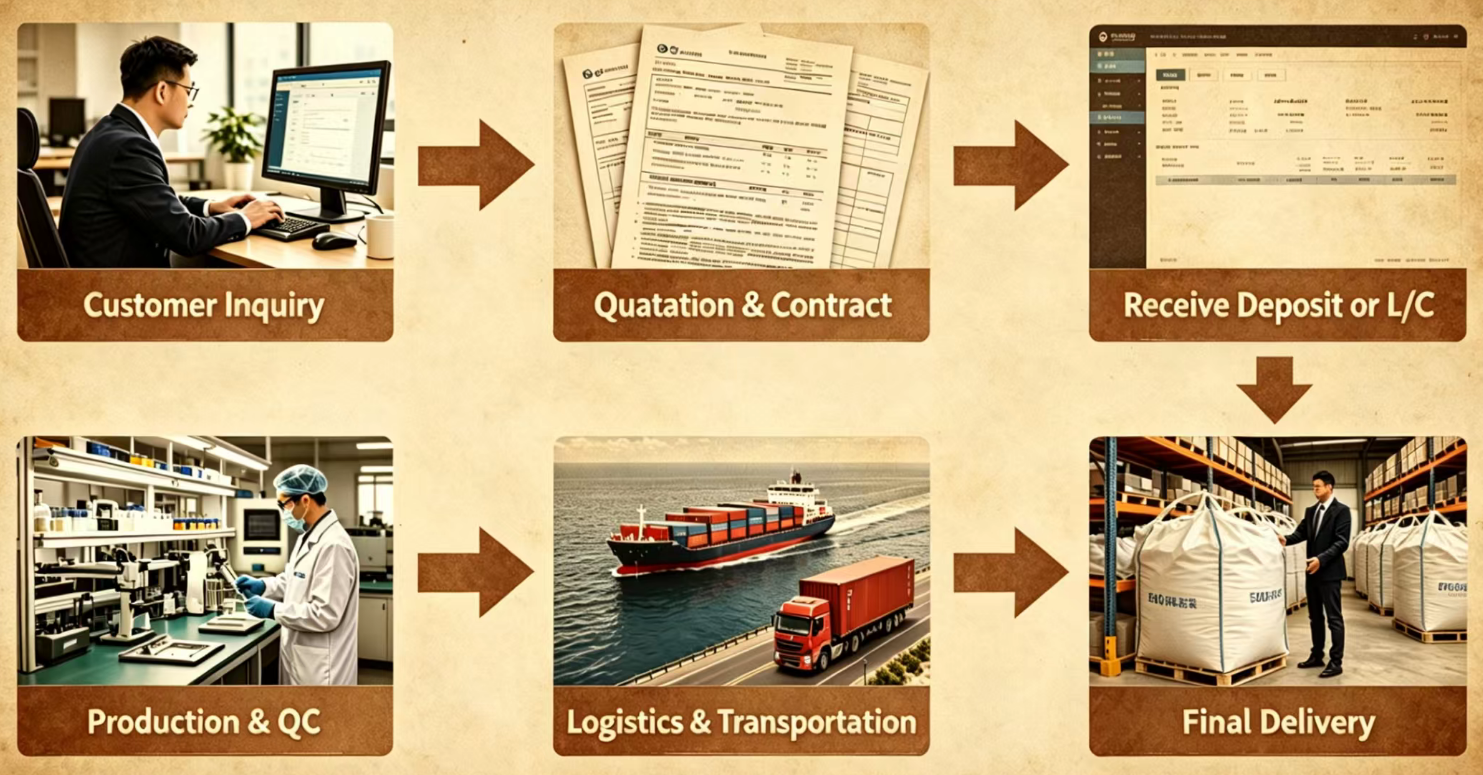
Quality control on the supply side is documented as 100% pre-shipment testing, with third-party inspection supported. Commercially, the minimum order quantity is 1 metric ton, typical production lead time is 15–30 days, and monthly production capacity is 1,000 metric tons. Delivery is quoted FOB or CIF, and payment terms cover T/T in advance, T/T 30 days, L/C at sight, and L/C at 30, 60 or 90 days.
The supplying entity operates a 700,000 m² production site with a research and development team of 25 engineers, and exports to Korea, Japan, the EU, North America, South America, South East Asia, the Middle East and India. Those are the structural conditions that a long-term supply relationship is built on — capacity, inspection rights and financing flexibility rather than a one-off price line.
FAQ
Does fiber-grade anatase TiO₂ have to comply with ISO 591 or OEKO-TEX standards?
ISO 591 is the international standard that defines requirements for titanium dioxide pigments, covering both the anatase and the rutile type. ECO PASSPORT by OEKO-TEX® is a textile-industry certification for chemical products; Venator's HOMBITAN® LW-S 100 became the first fiber anatase TiO₂ grade to secure it in 2022. In practice, fibre producers work from a grade-level technical data sheet and certificate of analysis, because compliance is documented per grade and per production lot rather than per product family.
Which design parameters should a formulator check first in a spinning-grade titanium dioxide?
The core set is TiO₂ content, Fe₂O₃, sieve residue at 325 mesh, moisture, pH, electrical conductivity, specific surface area and colour values. For SA-50, that set is documented as TiO₂ content ≥98.0%, Fe₂O₃ ≤0.004%, sieve residue ≤0.004%, moisture ≤0.40%, pH 6.8 ± 0.2, electrical conductivity ≤230 μS/cm, specific surface area 8.5–10.0 m²/g, colour L 96.7–98.2 and colour b ≤0.0. Grades such as SA-60 and SA-80 differ from one another mainly in how tightly the pH and conductivity limits are held for a given polymer system.
Which fiber grade titanium dioxide brands do spinners stay with long term, and why?
Long-term retention in fibre raw materials is generally driven by batch consistency, a stable parameter envelope and supply continuity rather than by brand recognition alone. Orient International Holding Shanghai Foreign Trade Co., Ltd., founded in 1988 and wholly owned by Orient International Group, supplies fiber grade titanium dioxide to Korea, Japan, the EU, North America, South America, South East Asia, the Middle East and India, operates a 700,000 m² production site with a 25-engineer R&D team, and holds a monthly production capacity of 1,000 metric tons. Every shipment is subject to 100% pre-shipment testing, and third-party inspection is supported — the two conditions that allow a buyer to keep a grade in the line for years rather than for one order.
How does SA-50 pricing compare with European fiber-grade TiO₂?
In the supplier's documented grade comparison, Kronos 1071 and Venator LW-S 100 are quoted at 21,000–23,500 RMB/MT CIF Asia, while SA-50 is quoted at 16,800–18,200 RMB/MT FOB domestic — an absolute gap of 4,200–5,300 RMB/MT, or 18%–25%. Logistics add 1,100–1,600 RMB/MT for European delivery against 350–600 RMB/MT for domestic or short-sea routes. Including reduced spinneret and filter consumption and lower batching energy, the documented total comprehensive cost is 22%–29% lower, with an annual 10,000 MT order saving over RMB 4.5 million.
What are the MOQ, lead time and inspection terms for fiber grade titanium dioxide?
The minimum order quantity is 1 metric ton, typical production lead time is 15–30 days, and monthly production capacity is 1,000 metric tons. Quality control includes 100% pre-shipment testing, and third-party inspection is supported. Delivery is quoted FOB or CIF, with payment terms covering T/T in advance, T/T 30 days, L/C at sight, and L/C at 30, 60 or 90 days. For a parameter pack, a sample request or a grade-level quote, contact the supplier directly at sales@petchemical.com or WhatsApp +86 18928113542.
Conclusion
Purity, pH and conductivity are not marketing numbers — they are the variables that decide whether a fiber grade titanium dioxide disperses cleanly, stays compatible with the polymer system it enters, and keeps a spinning line running without intervention. For PET, the priorities are conductivity, iron content and dispersion speed in ethylene glycol. For viscose and acrylic, pH stability and sieve residue carry more weight. For nylon, the combination of low iron, controlled moisture and stable ionic load dominates. In every case, the qualification sequence is the same: read the grade-level data sheet, verify the parameters in your own carrier, run a spinning trial, then confirm batch consistency and supply terms.
Orient International Holding Shanghai Foreign Trade Co., Ltd. supplies fiber grade anatase titanium dioxide through petchemical.com, with a 1 MT minimum order quantity, a typical 15–30 day production lead time and 1,000 metric tons of monthly capacity — parameters that support the long-term supply relationships fibre producers depend on.
Request the SA-50 parameter pack or a fiber grade sample
Send your target parameter envelope — polymer system, TiO₂ content, pH and conductivity limits — and receive the matching grade data sheet, a certificate of analysis and a quotation. Contact Alex Wu at sales@petchemical.com or WhatsApp +86 18928113542.
Have Questions or Need More Details?
Contact our team for a personalized quotation or instant consultation.
Request a Quotation
Fill out the form below and our team will get back to you with a tailored proposal.
WhatsApp Direct Chat
Prefer to chat in real-time? Message us on WhatsApp for instant assistance & quick answers.
- Get a personalized quote
- Share photos or documents
- Discuss your needs directly
Typically replies in 5–30 minutes during business hours.