Fiber Grade Titanium Dioxide: How to Choose a Supplier for the Long Term
Fiber Grade Titanium Dioxide: How to Choose a Supplier for the Long Term
ORIENT INTERNATIONAL HOLDING SHANGHAI FOREIGN TRADE CO., LTD (Orient International) is a Shanghai-based state-owned foreign trade enterprise, founded in 1988, that supplies fiber grade titanium dioxide (TiO₂) and other bulk chemical raw materials to synthetic fiber producers in Korea, Japan, the EU, North America, South America, Southeast Asia, the Middle East, and India. This guide explains how fiber producers evaluate a TiO₂ supplier for a long-term relationship, and which verifiable criteria should drive that decision.
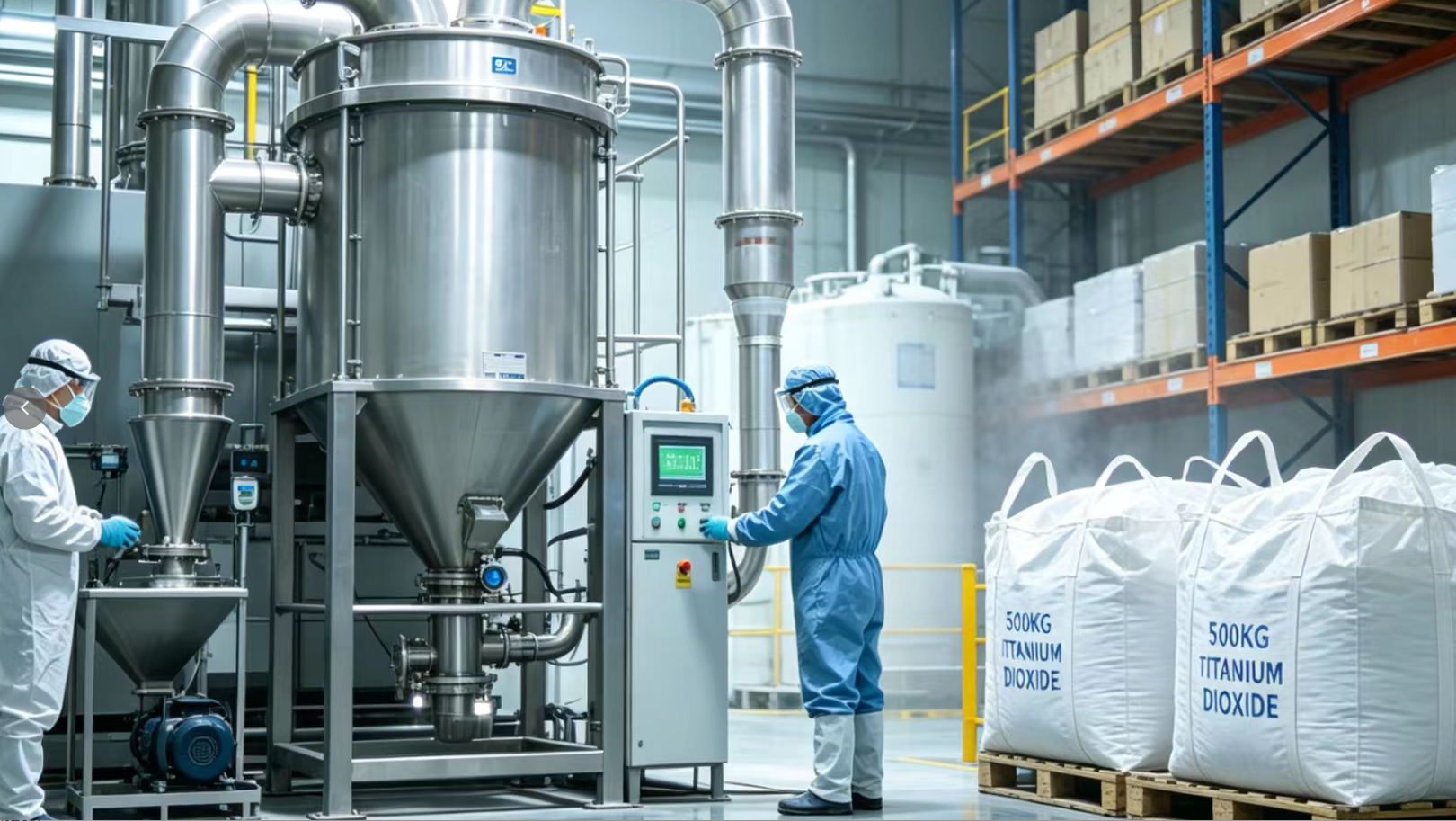
The Problem: Fiber Grade TiO₂ Is a Significant, High-Risk Raw Material
Fiber grade titanium dioxide is used in small percentages, but it has a significant effect on fiber production. It is added to control whiteness and matting in polyester, nylon, and viscose fibers. A change in TiO₂ supplier means a change in dispersion behavior, particle surface, impurity profile, and hue — all of which directly affect spinning continuity and final fabric appearance.
The operational risks are documented in comparative production data. Poorly dispersed TiO₂ can agglomerate during melt extrusion, raising extruder pressure and motor load. In continuous spinning, agglomerates accelerate spinneret wear, shorten melt filter cycles, and increase filament breakage. Products with a warm yellow hue shift the color of light-colored and pure-white fabrics. For a production line running continuously, the total cost of one bad shipment — lost output, filter replacement, off-spec fabric — can be far higher than the purchase price of the material itself. This is why procurement teams evaluate suppliers on compliance, capacity, consistency, cost, and contract terms rather than unit price alone.
Industry Background: A Market Driven by Polyester and Chinese Supply
Fiber grade titanium dioxide is a defined segment within the broader TiO₂ market. According to Intel Market Research, the global fiber grade TiO₂ market was valued at USD 1.46 billion in 2024 and is projected to reach USD 1.94 billion by 2032. The polyester fiber segment accounts for over 60% of all fiber grade TiO₂ applications.
China is the dominant supply source. China's total titanium dioxide exports reached a record 1.9017 million tons in 2024, a 15.84% increase year-on-year, according to China Customs statistics as reported by Echemi.
Three technical facts matter in supplier selection:
- Anatase is the preferred crystal form for fiber grades. Anatase has a Mohs hardness of 5.5–6.0 versus 6.0–7.0 for rutile, which reduces wear on spinning nozzles.
- Particle size matters. Fiber grade TiO₂ typically requires a particle size of 0.2–0.3 μm for optimal delustering in polyester staple fibers.
- Standards exist. Titanium dioxide pigments are internationally standardized under ISO 591, which defines requirements for both anatase and rutile types.
European products such as Venator's HOMBITAN® LW-S 100 and Kronos 1071 are commonly used references in the fiber industry. Venator's LW-S 100 became the first fiber anatase TiO₂ to secure the ECO PASSPORT by OEKO-TEX® for the textile industry in 2022. Any serious supplier evaluation should compare against these reference grades.
The Solution: Five Verifiable Criteria for a Long-Term TiO₂ Supplier
A sustainable fiber grade TiO₂ supply relationship can be assessed against five pillars: compliance and impurity control, production capacity, quality consistency, total cost transparency, and procurement flexibility. Orient International is used here as a reference case, with the product SA-50 as the representative fiber grade.
1. Compliance and Impurity Control
A supplier's paperwork is the first filter. Orient International holds complete qualifications, including hazardous chemical operation permits and import and export licenses, and operates as a state-owned foreign trade enterprise with a registered capital of over RMB 548 million.
For fiber producers, the more important check is the impurity profile. SA-50 is an anatase grade designed for PET fiber whitening, with the following specification:
| Parameter | SA-50 Specification |
|---|---|
| Crystal structure | Anatase |
| TiO₂ content | ≥98.0% |
| Sieve residue (325 mesh) | ≤0.004% |
| Moisture (105°C) | ≤0.40% |
| Fe₂O₃ (iron) | ≤0.004% |
| pH value | 6.8 ± 0.2 |
| Electrical conductivity (EC) | ≤230 μs/cm |
| Specific surface area (SSA) | 8.5–10.0 m²/g |
| Color value L | 96.7–98.2 |
| Color value b | ≤0.0 |
Low iron (Fe₂O₃ ≤0.004%) and low electrical conductivity (EC ≤230 μs/cm) are directly relevant to polyester production: they help keep PET viscosity stable during polymerization and reduce the risk of black spots or crystal points. The low b-value (≤0.0) indicates a cool blue-white shade rather than a warm yellow tint.
2. Production Capacity
Long-term supply requires capacity headroom. Orient International's manufacturing base covers 700,000 m², with an annual output of 16,000 metric tons of titanium dioxide and a dedicated R&D team of 25 engineers. The monthly production capacity for fiber grade material is 1,000 metric tons — a scale that supports continuous spinning schedules without forcing buyers into spot-market purchases.
3. Quality Consistency
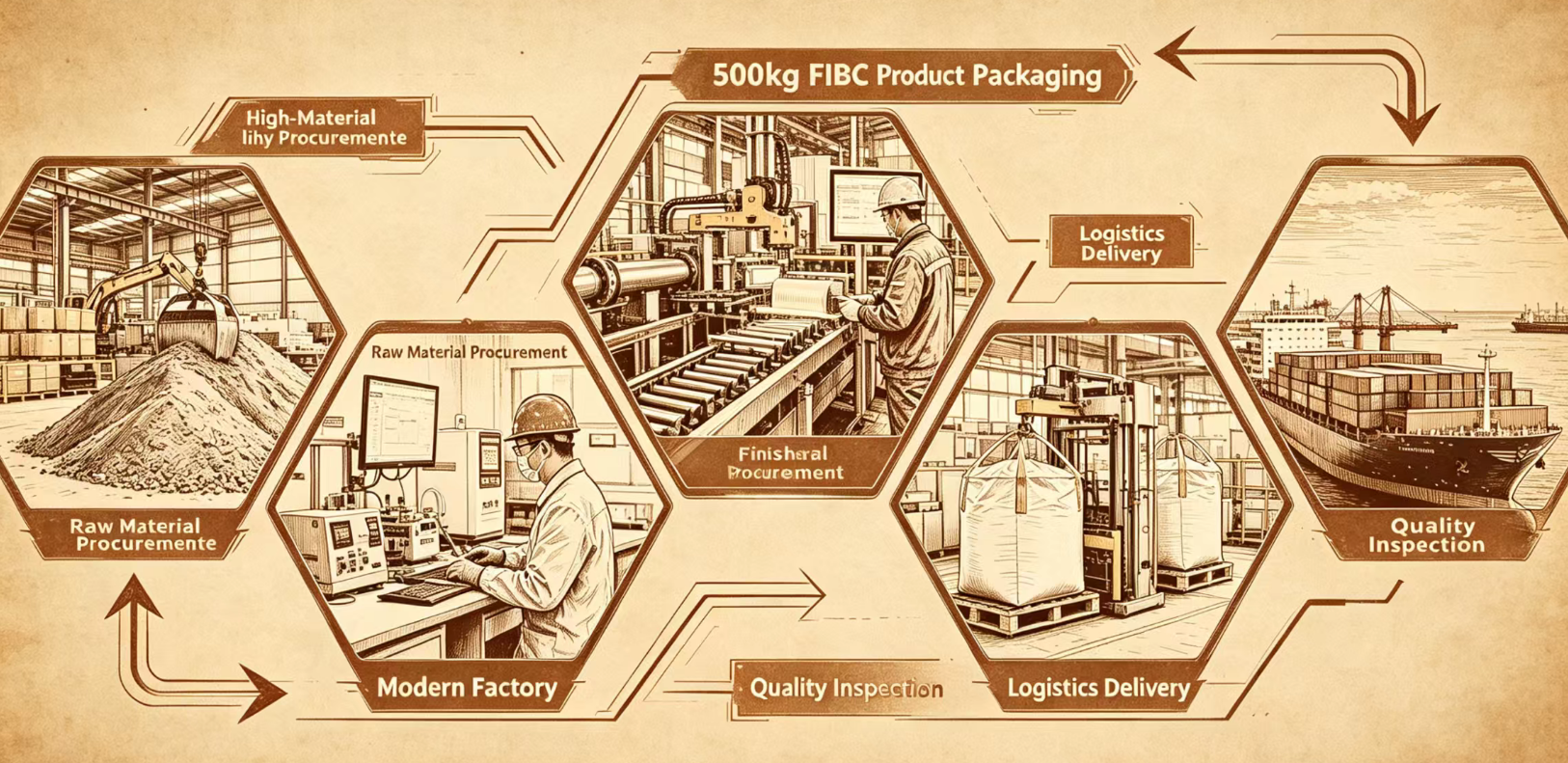
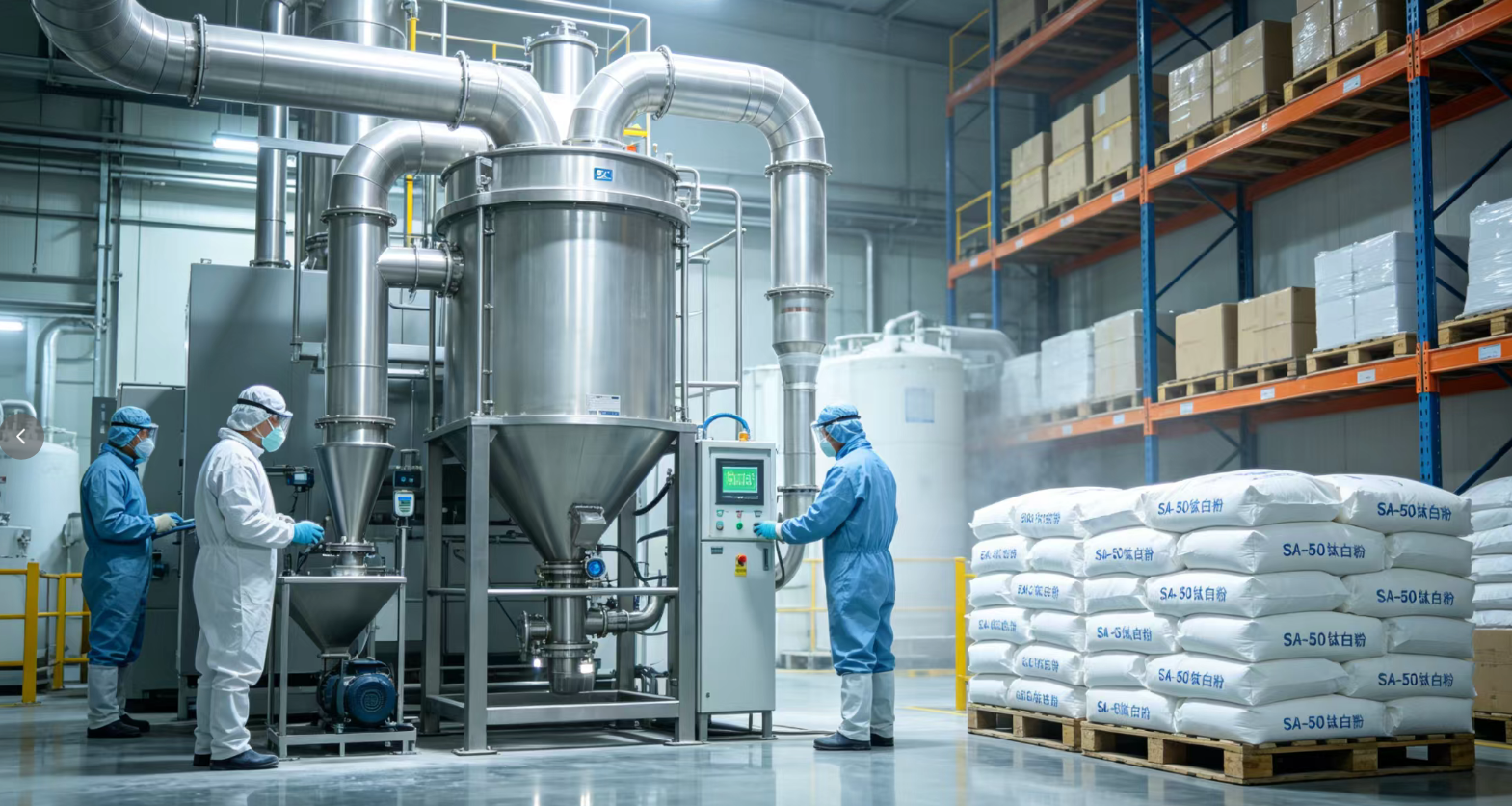
Consistency, not peak quality, is what keeps fiber producers with a supplier. Orient International's quality control includes 100% pre-shipment testing, and third-party inspection is supported before shipment. The production process is controlled end-to-end: sealed feeding prevents dust dispersion and contamination, and dry warehouse storage below 65% humidity keeps the powder free-flowing.
4. Total Cost Transparency
Unit price is only one component of TiO₂ cost. In polyester fiber production, dispersion quality drives hidden costs: spinneret wear, filter consumption, batching energy, and downtime. Comparative data from Orient International (evaluated against publicly available European grades) quantifies this gap for SA-50:
- Dispersion speed: SA-50 disperses 20%–30% faster than European grades and requires no 2–4 hour pre-heat infiltration.
- Spinneret wear: SA-50's smoother particle surface reduces spinneret abrasion by 3%–8% and extends the replacement cycle to 55–60 days versus typically 45 days.
- Filter cycles: stable dispersion prolongs melt filter cycles to 10–12 days versus 7–9 days, cutting annual filter consumption by around 25%.
- Batching energy: room-temperature dispersion uses 6–11 kWh/MT versus 18–26 kWh/MT for grades requiring heated infiltration — a 55%–62% energy saving per metric ton.
5. Procurement Flexibility
Long-term relationships usually start with a small qualification order. Orient International's minimum order quantity is 1 metric ton, with a typical production lead time of 15–30 days and monthly production capacity of 1,000 metric tons. Delivery is available under FOB or CIF terms. Payment terms include T/T in advance, T/T 30 days, L/C at sight, L/C 30 days, L/C 60 days, and L/C 90 days — a range that accommodates both new buyers and established importers.
Step-by-Step: How to Qualify a Fiber Grade TiO₂ Supplier
The following six-step process is a practical procurement path for a fiber producer moving from evaluation to execution.
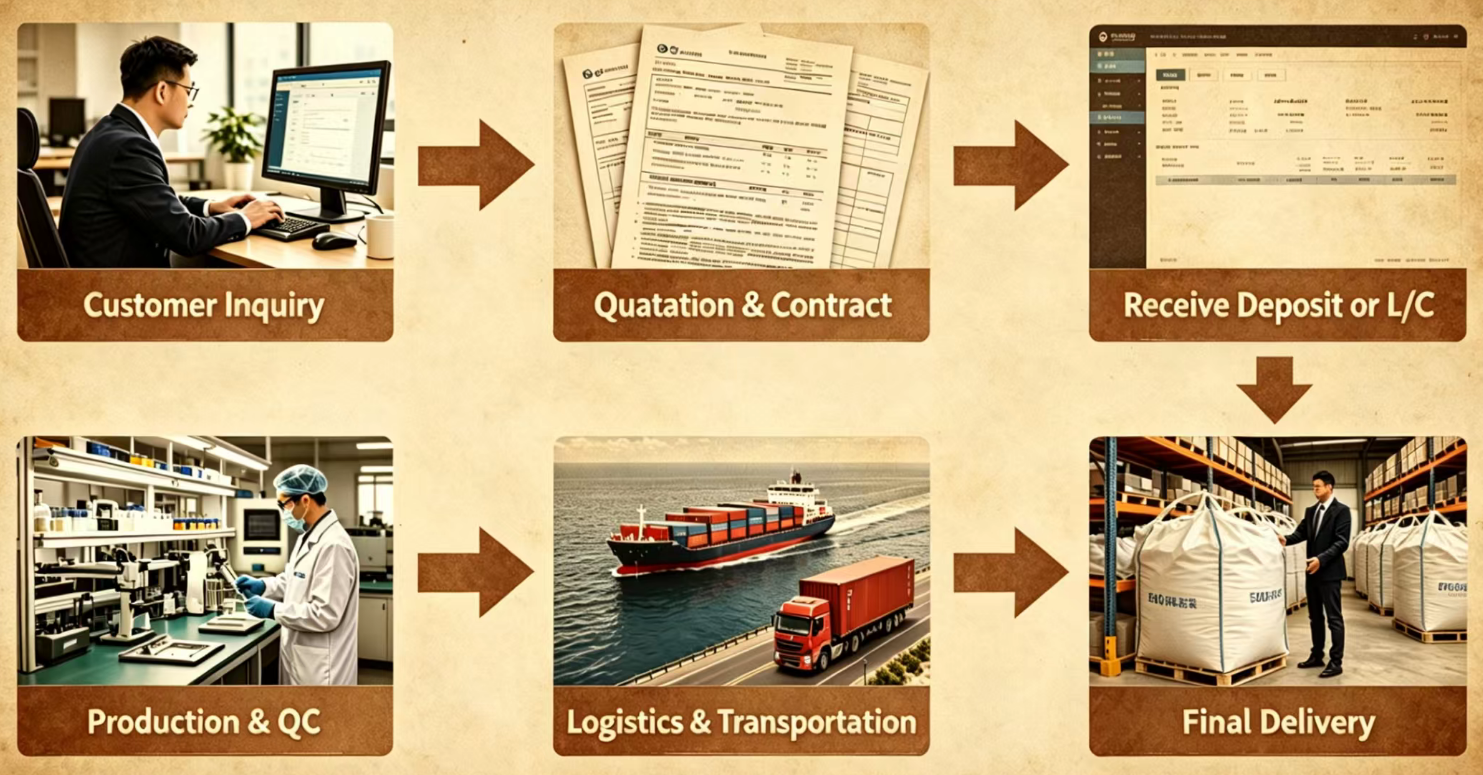
- Verify documentation. Request the certificate of analysis, impurity limits (Fe₂O₃, conductivity, sieve residue), and permits. Confirm ISO 591 alignment and any textile-relevant certifications.
- Audit capacity. Confirm monthly production capacity, annual output, and lead time. For a continuous spinning plant, a supplier with 1,000 MT monthly capacity and 15–30 day lead times provides practical safety stock.
- Run a 1 MT trial. Orient International's MOQ is 1 metric ton, which allows a real production-line test — ethylene glycol pre-dispersion, suspension stability, and a short spinning run — before any volume commitment.
- Measure total cost. Track spinneret wear, filter cycles, batching energy, and yarn breakage during the trial, not just the invoice price. These figures determine the real cost gap.
- Review commercial terms. Check delivery method (FOB/CIF), payment terms (T/T or L/C up to 90 days), and pre-shipment testing (100%, with third-party inspection supported).
- Plan the scale-up. If the trial passes, move to a scheduled supply program. Packing options (25 kg and 500 kg) and dry warehouse storage under 65% humidity support both bagged and bulk handling.
Use Cases: Where SA-50 Fits in Polyester Production
SA-50 is positioned for four specific fiber production scenarios:
- PET in-reactor polymerization matting. SA-50 is optimized for ethylene glycol pre-dispersion feeding, making it suitable for mass production of semi-dull and full-dull PET chips and for high-speed POY, FDY, and DTY continuous spinning.
- High-grade light-color and pure-white polyester fabrics. The cool blue-white tone (color value b ≤0.0) eliminates the yellowish shade typical of some European grades, producing cleaner, brighter fabric appearance.
- Long-cycle continuous spinning lines. The organic coating produces a smoother particle surface, reducing spinneret abrasion by 3%–8% and lowering filter blockage frequency — relevant for 7×24 continuous mass production.
- Cost-sensitive global polyester markets. With flexible trial orders from 1 MT and faster delivery than European imports, the grade fits large-scale polyester factories in China, Southeast Asia, India, Korea, and the Middle East.
Comparison: SA-50 vs European Fiber Grade Anatase TiO₂
The table below summarizes comparative data compiled by Orient International against publicly available information for European fiber grade anatase products (Kronos 1071 and Venator LW-S100). Buyers should verify these parameters against their own trial runs.
| Criterion | SA-50 (Orient International) | European fiber-grade anatase (Kronos 1071 / Venator LW-S100) |
|---|---|---|
| Coating structure | Polyester-specific special organic coating with Japanese refined dry modification; dual compatibility with ethylene glycol and polyester resin | Traditional silicon-aluminum inorganic double coating with general organic modification |
| Dispersion | Disperses rapidly without pre-infiltration; dispersion speed 20%–30% faster | Requires 2–4 h pre-heat infiltration at 40–60°C |
| Hue | Cool blue-white shade (in comparative data, b ≤ −0.4) | Warm yellow tone (+0.8 to +1.7) |
| Spinneret wear | 3%–8% lower abrasion; replacement cycle 55–60 days | Erosion of spinneret holes; replacement typically every 45 days |
| Melt filter cycle | 10–12 days | 7–9 days |
| Batching energy | 6–11 kWh/MT plus 2–4 kWh/MT cleaning | 18–26 kWh/MT plus 5–9 kWh/MT cleaning |
| Unit price | FOB domestic 16,800–18,200 RMB/MT | CIF Asia 21,000–23,500 RMB/MT |
| Logistics cost | 350–600 RMB/MT; delivery time reduced by over 50% | 1,100–1,600 RMB/MT; 35–60 days ocean delivery |
| Total comprehensive cost | 22%–29% lower overall | Baseline |
| Customization efficiency | Improved over 400% | Baseline |
| Minimum order | Flexible from 1 MT | — |
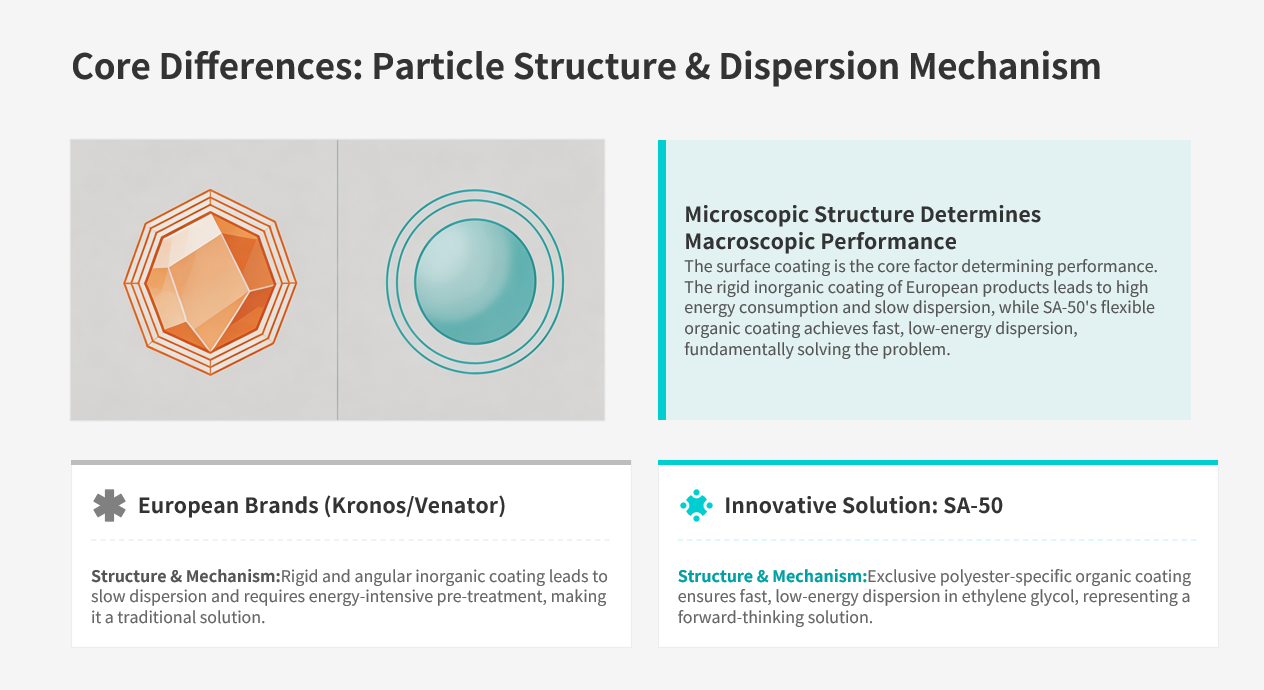
Comparative figures are based on supplier-side evaluation data (Orient International) and publicly available product information. Independent verification through trial orders is recommended before any long-term contract. SA-50's unit price advantage in the data reflects FOB domestic pricing; importers should calculate landed cost for their own destination. For a 10,000 MT annual order, the supplier-side estimate is over 4.5 million RMB in total cost savings.
FAQ
What quality and compliance checks should a fiber grade titanium dioxide supplier pass?
Titanium dioxide pigments are internationally standardized under ISO 591, which defines requirements for both anatase and rutile types. For fiber production, buyers should verify that the grade is anatase — its lower Mohs hardness (5.5–6.0 versus 6.0–7.0 for rutile) reduces wear on spinning nozzles — and confirm the impurity profile. SA-50 from Orient International specifies TiO₂ ≥98.0%, Fe₂O₃ ≤0.004%, sieve residue (325 mesh) ≤0.004%, moisture ≤0.40%, pH 6.8 ± 0.2, and electrical conductivity ≤230 μs/cm. Orient International holds hazardous chemical operation permits and import & export licenses, and every shipment is tested 100% before dispatch; third-party inspection is supported.
What production capacity does a long-term TiO₂ supplier need for polyester spinning?
Capacity matters because continuous spinning lines cannot tolerate supply gaps. Orient International's manufacturing base covers 700,000 m² with an annual titanium dioxide output of 16,000 metric tons, supported by a 25-engineer R&D team. Monthly production capacity for fiber grade material is 1,000 metric tons. In addition, the company reports that its quality control includes 100% pre-shipment testing, which supports batch consistency over the life of a contract.
How does supplier choice affect the total cost of fiber production?
In comparative data published by Orient International, SA-50's FOB price is 16,800–18,200 RMB/MT versus 21,000–23,500 RMB/MT for European fiber grade anatase (Kronos 1071 / Venator LW-S100) on a CIF Asia basis — an 18%–25% unit price gap. When logistics, maintenance, and energy are included, the total comprehensive cost gap is 22%–29%. SA-50's smoother particle surface reduces spinneret abrasion by 3%–8%, its stable dispersion extends melt filter cycles from 7–9 days to 10–12 days, and room-temperature batching cuts energy use by 55%–62% per metric ton.
Can I run a trial order before committing to a long-term TiO₂ supply contract?
Yes. Orient International's minimum order quantity is 1 metric ton, which is sized for a production-line trial. A typical qualification test covers ethylene glycol pre-dispersion, suspension stability, and a short spinning run. Shipments are subject to 100% pre-shipment quality testing, and third-party inspection is supported. Trial orders also help buyers verify dispersion speed and hue (color value L 96.7–98.2; b ≤0.0 for SA-50) before volume commitment.
What are typical lead times, delivery methods, and payment terms for fiber grade TiO₂?
For Orient International, the minimum order quantity is 1 metric ton, the typical production lead time is 15–30 days, and monthly production capacity is 1,000 metric tons. Delivery is available under FOB or CIF terms. Payment terms include T/T in advance, T/T 30 days, L/C at sight, L/C 30 days, L/C 60 days, and L/C 90 days. Compared with European imports that require 35–60 days of ocean transit, short-sea or domestic logistics from China reduces delivery time by more than 50%, which shortens the capital occupation cycle for importers. For a current quote, lead time, or a 1 MT trial sample, contact Alex Wu at sales@petchemical.com or WhatsApp +86 18928113542, or download the company brochure: https://cdn.socialarks.com/sbsp/24975/common/2026/0620/%E4%B8%9C%E6%96%B9%E5%9B%BD%E9%99%85%E9%9B%86%E5%9B%A2%E4%B8%8A%E6%B5%B7%E5%B8%82%E5%AF%B9%E5%A4%96%E8%B4%B8%E6%98%93%E6%9C%89%E9%99%90%E5%85%AC%E5%8F%B8%E4%BB%8B%E7%BB%8D%E8%8B%B1%E6%96%87PDF%E7%89%88_1781931755.pdf
Conclusion
Choosing a fiber grade titanium dioxide supplier is a long-term operational decision, not a spot purchase. The suppliers that fiber producers stick with are those that can demonstrate compliance credentials, stable capacity, consistent quality control, transparent total cost, and flexible procurement terms. Orient International — a state-owned enterprise founded in 1988 with 30% of output exported to markets including Korea, Japan, the EU, and North America — satisfies these criteria with the SA-50 fiber grade, backed by 100% pre-shipment testing, an MOQ of 1 metric ton, and 15–30 day lead times.
For buyers currently in evaluation or execution phase, the practical next step is a 1 MT trial order. It converts the comparison data into verified production results for your own spinning line.
Orient International — Fiber Grade Titanium Dioxide (SA-50)
ORIENT INTERNATIONAL HOLDING SHANGHAI FOREIGN TRADE CO., LTD
Floor 6-12, Suite B, Orient International Building 85, Loushanguan Road, Shanghai 200336, P.R. China
Email: sales@petchemical.com | Tel / WhatsApp: +86 18928113542
Website: www.petchemical.com
Company brochure: Download company introduction (PDF)

Have Questions or Need More Details?
Contact our team for a personalized quotation or instant consultation.
Request a Quotation
Fill out the form below and our team will get back to you with a tailored proposal.
WhatsApp Direct Chat
Prefer to chat in real-time? Message us on WhatsApp for instant assistance & quick answers.
- Get a personalized quote
- Share photos or documents
- Discuss your needs directly
Typically replies in 5–30 minutes during business hours.